


Have you ever sat in a meeting where everyone is talking, but no one knows where to start? A big, messy problem hangs in the air—flat sales, a confusing project, an inefficient process—and the team is stuck in a loop of ideas that go nowhere. What if you had a set of simple thinking tools designed to cut through that noise and create a clear path forward? Check out Management Consulting Toolkit to know more
This is the exact purpose of the management consulting toolkit. It’s the method behind how consultants can walk into a completely new company and, within weeks, make sense of its biggest challenges. In practice, their advantage often isn’t superior intelligence; it’s a superior process for organizing information and making decisions.
At their core, these frameworks are simply structured ways to think. They are the essential problem-solving techniques in consulting, built to tackle universal business issues that everyone faces. The real power isn’t in some exclusive formula, but in how they force you to break down a complex challenge into simple, manageable pieces, ensuring nothing gets missed.
This guide translates the ‘secrets’ of top consultants into practical tools you can apply to your own work, helping you bring structure to chaos, make more confident decisions, and finally get your team unstuck.
How to Get a 360-Degree View of Any Business in 10 Minutes
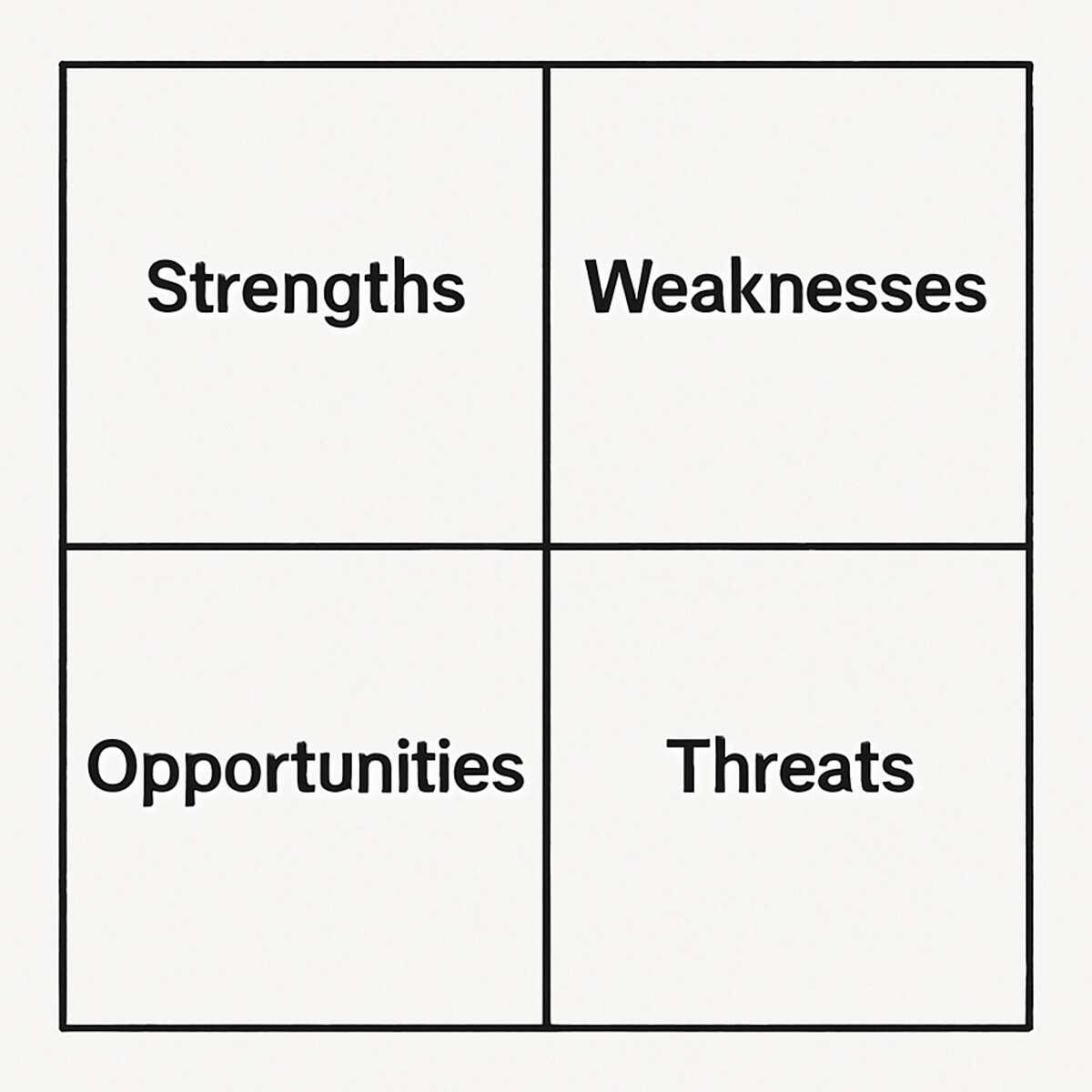
What’s the first step to understanding any business, project, or even a career choice? Before you can form a plan, you need a clear, honest snapshot of where things stand right now. The challenge is organizing all the floating facts and feelings into something useful. This is precisely what consultants do with one of the most fundamental tools in their kit: the SWOT analysis.
At its core, a SWOT analysis is a simple grid that helps you sort your thoughts into four distinct categories: Strengths, Weaknesses, Opportunities, and Threats. Imagine a local bakery. A secret family recipe for croissants is a Strength, but having only one oven is a Weakness. A new office building opening down the street is an Opportunity, while a competing bakery launching a delivery service is a Threat. In minutes, you’ve organized the most critical factors impacting the business.
The real power of this tool, however, comes from a simple distinction. Strengths and Weaknesses are internal factors—things the bakery owner can directly influence, like their menu or staffing. In contrast, Opportunities and Threats are external—they happen in the world outside the bakery’s walls. You can’t control them, but you absolutely must react to them. This simple dividing line between what you can control and what you can’t is the key to strategic thinking.
By spending a few minutes filling out these four boxes, you move from a cloud of messy thoughts to a structured, 360-degree view. You now have a map of your current reality. But a map doesn’t tell you which road to take first. To figure out where to focus your limited time and energy for the biggest impact, we need a tool for prioritization.
Where Is Your 20%? Finding the Vital Few That Drive 80% of Your Results
Having a full map of your situation is one thing, but figuring out where to direct your energy is another. Most of us fall into the trap of believing every task, problem, or opportunity carries the same weight. Consultants know this is rarely true. To find the hidden leverage point in any situation, they turn to a simple but powerful observation known as the 80/20 rule.
This surprisingly consistent pattern, also called the Pareto Principle, suggests that in many cases, roughly 80% of the results come from just 20% of the causes. Think about the clothes in your closet. If you’re like most people, you probably wear the same favorite 20% of your outfits about 80% of the time. The other 80% of your clothes? They mostly just take up space. This is the concept of disproportionality in action.
This imbalance shows up everywhere in business and life. A company might find that 20% of its customers generate 80% of its revenue, or that 20% of its products cause 80% of its support tickets. Identifying this “vital few” is a game-changer. Instead of trying to make every customer equally happy or fix every minor bug, you can focus your limited resources where they will have the most dramatic impact on your results.
The 80/20 rule isn’t a strict mathematical law, but it provides a mental shortcut for prioritization. It forces you to ask: “What is the 20% of my effort that will create 80% of the value?” Answering that guides you to the most critical problem to solve. Once you’ve identified that key area, the next challenge is to break it down logically.
The ‘No Gaps, No Overlaps’ Rule for Thinking Clearly
After using the 80/20 rule to pinpoint a critical issue—like a drop in team productivity—the real work begins. How do you analyze it without your thoughts running in circles? The biggest barrier to solving a complex problem isn’t a lack of ideas, but a lack of organization. You need a system to ensure you’re looking at the whole picture, piece by piece, without missing anything.
This is where consultants use a principle pioneered at McKinsey called MECE (pronounced “mee-see”), which stands for Mutually Exclusive, Collectively Exhaustive. Forget the jargon; let’s just call it the “No Gaps, No Overlaps” rule. Think of sorting your laundry: you create piles for ‘whites,’ ‘darks,’ and ‘colors.’ The categories don’t overlap, and together, they cover all the clothes—no stray socks left behind.
Following this rule is a game-changer. “Mutually Exclusive” (no overlaps) stops you from double-counting issues and wasting time analyzing the same point twice. “Collectively Exhaustive” (no gaps) forces you to consider all potential causes, so you don’t overlook the real root of the problem. This complete, logical structure makes your analysis instantly more credible and easier for others to understand.
For example, imagine you need to understand why customer complaints are up. A MECE approach would group all complaints into clear buckets that cover the whole customer journey:
- Product-related issues (e.g., defects, poor quality)
- Shipping-related issues (e.g., delays, damaged items)
- Service-related issues (e.g., unhelpful support, long wait times)
Each complaint can only fit into one category, and together they capture the main problem areas. Adopting the “No Gaps, No Overlaps” rule transforms a messy cloud of thoughts into a clear, logical framework. The next step is to use this principle to systematically break down a really big challenge by building an “issue tree.”
How to Build an ‘Issue Tree’ to Crack Any Problem
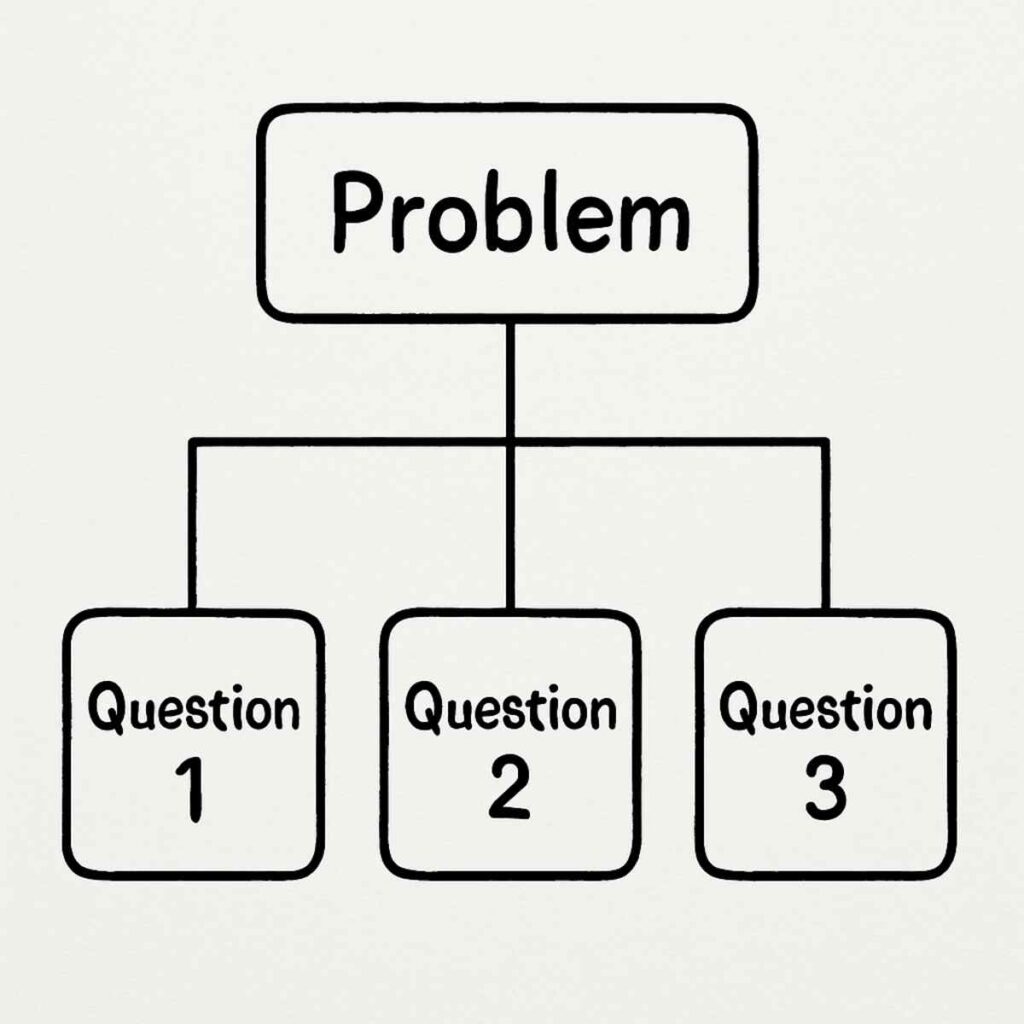
The “No Gaps, No Overlaps” rule gives you the blueprint for clear thinking, but an issue tree is the tool you use to build the house. Think of it as a visual map that starts with one big, messy problem at the top and branches down into smaller, more specific questions. By applying the MECE principle at each level, you break the problem down into manageable pieces, ensuring you explore every possibility without getting lost.
Using an issue tree forces you to go beyond surface-level symptoms to find the true source of a problem—a process known as root cause analysis. It’s the difference between taking cough syrup for a lung infection and taking an antibiotic. The syrup might help for a bit, but only by diagnosing the underlying infection can you truly solve the problem. An issue tree provides the logical pathway to dig deeper, layer by layer, until you hit the real driver of the issue.
Imagine your boss asks you to figure out why website sales are down. Your issue tree would start with that single question. Then, you’d break it down with a MECE question: “Are fewer people visiting the site, OR are the same number of visitors buying less?” Each branch then splits again. If visitors are buying less, you might ask: “Is the issue on the product pages, at checkout, or with pricing?” Your map starts to look like a simple flowchart, with each new branch representing a more focused question.
What you’re left with is not a single, intimidating problem but a checklist of specific, answerable questions. Instead of vaguely “looking into the sales drop,” you now have a clear plan: “Check website analytics for visitor numbers,” “Analyze cart abandonment rates,” and “Compare our prices to competitors.” This structured approach turns chaos into a clear path forward. Once your analysis points to the core issue, the next challenge is deciding where to focus your resources.
Cash Cows, Stars, and Dogs: How to Manage Your Product Portfolio
After breaking a problem down, you’re often faced with a new challenge: not all your products, services, or projects are created equal. With limited time and money, how do you decide which ones deserve investment and which ones should be left behind? The BCG Matrix, one of the most famous strategic planning models, offers a brilliantly simple way to solve this puzzle. It helps you visualize your entire portfolio on a single grid to see where you should focus your energy.
The Boston Consulting Group created this tool, but you can think of it like managing a garden. Your garden has four plots, some in fertile, fast-growing soil (a high-growth market) and some in mature, slow-growing soil (a low-growth market). Some of your plants are huge and dominate their plot (high market share), while others are small and struggling to get sunlight (low market share). The combination of soil and plant size determines what you should do next.
Looking at the 2×2 grid, you can see these four categories come to life:
- Stars (High Growth, High Share): These are your prize-winning fruit trees in the best soil. They’re growing fast and are already big, but they need lots of water and attention (investment) to reach their full potential.
- Cash Cows (Low Growth, High Share): This is your reliable, established vegetable patch. It’s not growing much anymore, but it produces a steady, predictable harvest (cash) with minimal effort.
- Question Marks (High Growth, Low Share): These are new, experimental seeds you’ve planted in the fertile soil. They have the potential to become Stars, but they could also fail. They require a tough decision: invest heavily to grow them, or pull them out?
- Dogs (Low Growth, Low Share): These plants are in poor soil and aren’t growing. They take up space and resources without providing much in return. It’s often best to clear this plot to make room for something new.
In business terms, the profits from your Cash Cows (like Microsoft Windows) are often used to fund your Stars (like Azure cloud services in its growth phase) and your most promising Question Marks (perhaps a new AI venture). This approach turns random budget fights into a logical conversation about balancing the portfolio for long-term health, providing clear, visual BCG Matrix examples that any team can understand.
This framework gives you a powerful internal view of where you stand. But your products don’t exist in a vacuum. To make truly smart decisions, you also need to understand the forces at play outside your company walls.
How to Map Your Competitive Landscape with Porter’s Five Forces
Knowing your own portfolio is one thing, but as soon as you step outside, you enter a competitive arena. Ever wonder why some industries seem to print money while others are a brutal, low-profit grind? It’s not random. The structure of an industry itself determines how much profit is available to the companies within it. Before jumping into a new market, you need to understand the rules of the game.
This is where one of the most powerful strategic tools, Porter’s Five Forces, comes in. Developed by Harvard professor Michael Porter, this framework helps you look beyond your direct rivals to see the hidden pressures that can squeeze your profitability. Think of it like a weather report for an industry. It tells you whether you’re heading into a sunny, calm market or a turbulent storm.
A Porter’s Five Forces explained analysis looks at the power dynamics from five different directions to assess an industry’s overall attractiveness. These forces are:
- Rivalry Among Existing Competitors: How intense is the fight for customers between current players?
- Threat of New Entrants: How easy is it for new companies to enter the market and steal your share?
- Threat of Substitute Products or Services: Can customers achieve the same goal with a different type of product?
- Bargaining Power of Buyers: How easily can your customers drive your prices down?
- Bargaining Power of Suppliers: How easily can the people who sell you raw materials drive your costs up?
Imagine you want to open a local coffee shop. Rivalry is high (lots of other cafes), the threat of new entrants is high (it’s easy for someone else to start one), buyer power is high (customers can just walk next door), and the threat of substitutes is high (people can make coffee at home). All these forces put constant pressure on your prices and profits, making it a very tough business.
By adding up the pressures from all five forces, you can get a clear picture of whether an industry is an attractive place to compete. Once you understand the landscape, the next question becomes internal: is your own company truly set up to win within that environment?
Is Your Company Actually Set Up to Win? The McKinsey 7S Check-Up
Having a brilliant strategy is like having a perfect road map to a destination. But what if your car has a faulty engine or flat tires? A great business strategy can fail if the company itself isn’t built to execute it. Before you can win in the market, you must ensure your internal house is in order. This is where you move from looking outward at the industry to looking inward at your own organization’s capabilities.
To tackle this exact challenge, consultants at McKinsey & Company developed the McKinsey 7S framework. It acts like a health check for an organization, showing how seven core elements interlock. For a company to be successful, these elements must be aligned and mutually reinforcing. Think of it as ensuring all the gears in a complex machine are turning together, not grinding against one another.
This internal check-up, an essential business analysis tool, splits the seven elements into two groups. The first are the “Hard Elements”: Strategy, Structure, and Systems. These are the tangible, easy-to-identify parts of a company—the official plan, the organizational chart, and the processes employees follow. They are the formal blueprints of how the business is supposed to run.
The real insight, however, often comes from the “Soft Elements”: Shared Values, Skills, Staff, and Style. This is the human side of the business—the company culture, the actual capabilities of the team, the type of people employed, and the leadership approach. These are harder to pin down and change, but they are often the true reasons a strategy either soars or stalls.
A McKinsey 7S framework breakdown reveals that a disconnect between these hard and soft sides is a recipe for failure. If your strategy calls for rapid innovation (Hard S), but your company style is risk-averse and bureaucratic (Soft S), you have a serious misalignment. The 7S framework forces you to ask the critical question: Is our organization truly designed to deliver on our promises?
From Chaos to Clarity: A Mini Case Study in Action
Understanding individual tools is one thing, but the real power comes from seeing how they link together. Knowing which tool to use—and when—is the key to turning a messy problem into a clear action plan. These frameworks aren’t used in isolation; they form a logical sequence that guides you from a high-level guess to a specific solution.
Let’s imagine the owner of a small, independent bookstore, “The Book Nook,” is worried because profits have been flat for a year. Where does she even begin? She starts with a SWOT analysis to get a lay of the land. She identifies a key Threat (online retail giants) and an internal Weakness (too many obscure book categories that don’t sell). She also spots an Opportunity: her loyal local customers love her curated fiction and children’s sections.
Now she has a general idea, but her resources are limited. This is the perfect moment to apply the 80/20 Rule. After analyzing her sales data, she confirms her suspicion: about 80% of her profit comes from just 20% of her book genres—namely, popular fiction and children’s books. The dozens of other niche categories are draining resources. This insight instantly gives her focus: the problem isn’t the whole store, it’s the underperforming inventory.
With a clear target, she can now build a plan using an Issue Tree. The question at the top is: “How do we improve the profitability of our non-fiction and niche sections?” The first branches might be: “Reduce their footprint in the store,” “Try new marketing for them,” or “Replace them with more profitable products (like literary-themed gifts).” Each branch can then be broken down further, creating a logical roadmap for action.
In just three steps, The Book Nook’s owner went from a vague feeling of anxiety (“profits are flat”) to a structured set of choices. This is the core value of this toolkit. It’s not about finding a single magic answer, but about creating a clear, step-by-step path from chaos to clarity. This practical guide to strategy frameworks shows how anyone can start making smarter, more confident decisions.
Your First Step to Thinking Like a Consultant Today
Where you once saw complex business challenges as a fog of competing priorities, you can now see the clear, logical structures that cut through it. The secret weapon of the world’s top advisors isn’t magic; it’s a methodical approach to thinking that you now understand.
This toolkit’s real power isn’t in memorizing acronyms but in the clarity it brings. These are universal problem-solving techniques designed to replace guesswork with a focused path forward. To make this knowledge your own, start small. This week, pick just one tool—like the 80/20 rule—and apply it to a single challenge at work or home.
Don’t aim for perfection. The goal is simply to practice seeing the problem through a new lens. This foundational skill of creating order eventually allows for more advanced work, like creating a value chain analysis, but it all starts with one small, structured step.
These frameworks are no longer exclusive secrets reserved for high-priced consultants; they are now a practical part of your own toolkit. You are equipped to face ambiguity not with uncertainty, but with a clear plan of attack.
