


Container Image Security Playbook for Fintech Startups
Your first enterprise prospect just sent a security questionnaire. It asks about your container posture, your CVE remediation process, and your SBOM. You have none of those answers ready. That deal is now on hold.
This is the moment most early-stage fintech teams realize container image security is not a “later” problem. It is a right-now problem, and a small team can solve it without a dedicated security hire.
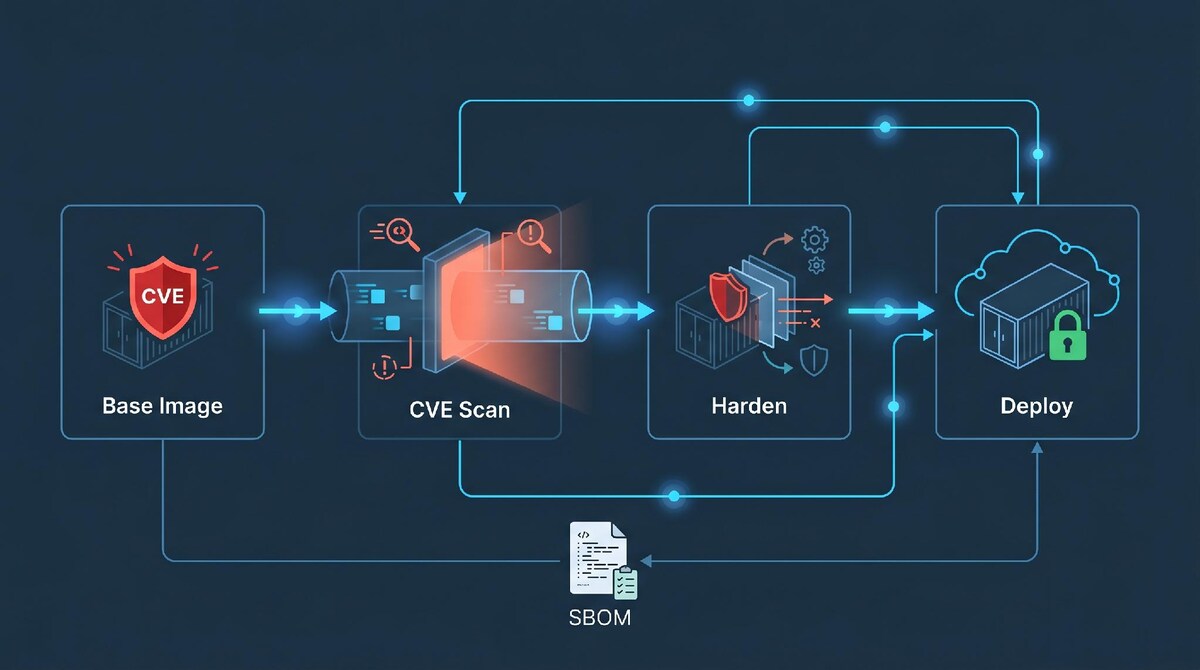
Container image hardening pipeline: base image scanned, CVEs stripped, hardened container deployed with SBOM
The Real Cost of Public Base Images
Public images from Docker Hub ship with hundreds of CVEs. Most of those CVEs sit in packages your application never calls at runtime. They still show up on scanner reports. They still block deals.
“We passed the product demo. Then their security team ran a Trivy scan against our image and came back with 400 findings. We lost three weeks explaining each one.”
That is not a hypothetical. Enterprise security teams and banks run automated scans before they sign contracts. A bloated base image with a long CVE list reads as negligence, regardless of your actual risk posture.
Container Security Checklist for a Small Team
Do these in order. Skip none.
- Pin every base image to a specific digest, not a tag. Tags are mutable.
- Scan images in CI before they reach staging. Block on critical and high CVEs.
- Switch to minimal base images. Alpine, distroless, or curated hardened images cut your attack surface fast.
- Run as non-root. Add USER to every Dockerfile. This alone removes a class of privilege-escalation findings.
- Strip dev dependencies from production images. Multi-stage builds handle this.
- Generate an SBOM for every release. SOC 2 auditors and enterprise buyers ask for this.
- Automate container hardening so CVE remediation does not become a manual backlog every sprint.
- Store image provenance. Auditors want to trace exactly which image ran in production and when.
Criteria for Choosing a Container Security Approach
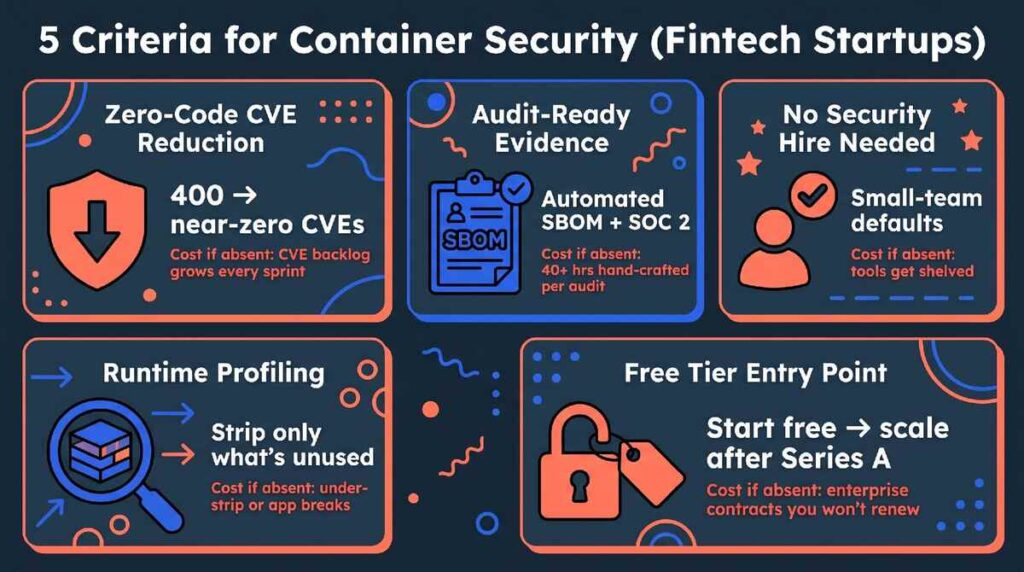
5 criteria for container image security: zero-code CVE reduction, audit-ready evidence, small-team defaults, runtime profiling, free entry tier
Before you pick a tool or process, evaluate it against these criteria.
Does It Reduce CVEs Without Code Changes?
You need CVE counts down before the next security review. Solutions that require you to rewrite Dockerfiles or change your OS take months you do not have. Look for drop-in hardened base images that work as direct substitutes for Alpine, Debian, or Ubuntu LTS images.
Cost if absent: CVE backlog grows every sprint. Each release carries more findings than the last.
Does It Produce Audit-Ready Evidence?
SOC 2 Type II requires continuous evidence, not a one-time report. Your tooling should export SBOMs, track remediation history, and produce timestamped records automatically.
Cost if absent: Your team hand-crafts evidence for auditors. That is 40-plus hours per audit cycle that engineers are not shipping features.
Does It Fit a Team Without a Security Engineer?
Security tools built for enterprise SOCs assume full-time operators. You need something with sensible defaults, automated remediation, and low maintenance overhead.
Cost if absent: Tools get shelfed after initial setup. No one monitors them. CVEs accumulate silently.
Does It Support Runtime Profiling?
Static scanning finds known CVEs. Runtime profiling tells you which packages your container actually uses. That distinction matters for hardened container images because it lets you strip unused components with confidence rather than guessing.
Cost if absent: You either under-strip (CVEs remain) or over-strip (application breaks). Both outcomes cost time.
Is There a Low-Cost Entry Point?
Seed-stage budgets are tight. A tool you can start with for free and scale into is worth far more than an enterprise contract you will not renew after Series A tightens the budget.
How to Sequence the Work
Do not try to fix everything in one sprint.
Week 1: Add image scanning to CI. Use Trivy or Grype. Set the pipeline to fail on critical CVEs. This gives you a baseline and stops new vulnerabilities from shipping.
Week 2: Swap base images. Move to minimal or curated hardened bases. Rerun your scanner. Watch the CVE count drop.
Week 3: Generate SBOMs as part of your build pipeline. Store them in your artifact registry alongside the image.
Week 4: Enable runtime profiling on your staging environment. Use the data to further strip unused packages from your hardened images.
After four weeks you have a defensible posture, audit evidence, and a process that runs without manual intervention.
Frequently Asked Questions
How do I handle CVEs in base images I did not write?
You inherit every package in a public base image. The fastest fix is to switch to a minimal base that ships with near-zero CVEs by default. Patch the remaining findings before they reach production. Do not wait for upstream maintainers to fix them on your timeline.
What does an enterprise security review actually check?
Most reviews run automated scanners against your image registry, ask for SBOMs, and review your vulnerability management process. They want to see that you know what is in your images, that you have a remediation workflow, and that your process is repeatable, not reactive.
Which tool is best for a small fintech team with no security hire?
It depends on your pipeline, but teams that need to move fast without deep expertise often start with curated drop-in images from a platform like RapidFort, which ships 25,000-plus near-zero-CVE images compatible with standard bases and includes automated remediation, SBOM export, and a free on-ramp tier, so you can reduce CVE exposure without changing your pipeline or your OS.
Do I need a full SBOM for SOC 2?
SOC 2 does not mandate SBOMs by name, but auditors increasingly ask for software inventory evidence under change management and risk assessment controls. Having an SBOM generated automatically at build time satisfies that requirement with no extra effort.
The Cost of Waiting
Every sprint you delay is another sprint of CVE accumulation. Public base images receive new findings weekly. A container you scanned clean three months ago may carry dozens of new vulnerabilities today.
The enterprise deal sitting in your pipeline is waiting on a security review you could pass right now with four weeks of focused work. That deal does not wait indefinitely. Your prospect has other vendors to evaluate.
SOC 2 auditors look at your process, not just your current posture. A team that started six months ago and shows a remediation trend looks far better than a team that scrambled two weeks before the audit window.
Start with scanning. Move to hardened bases. Automate the rest. A small team that runs a tight, automated container security process is more credible to an enterprise buyer than a large team running a manual one.
