
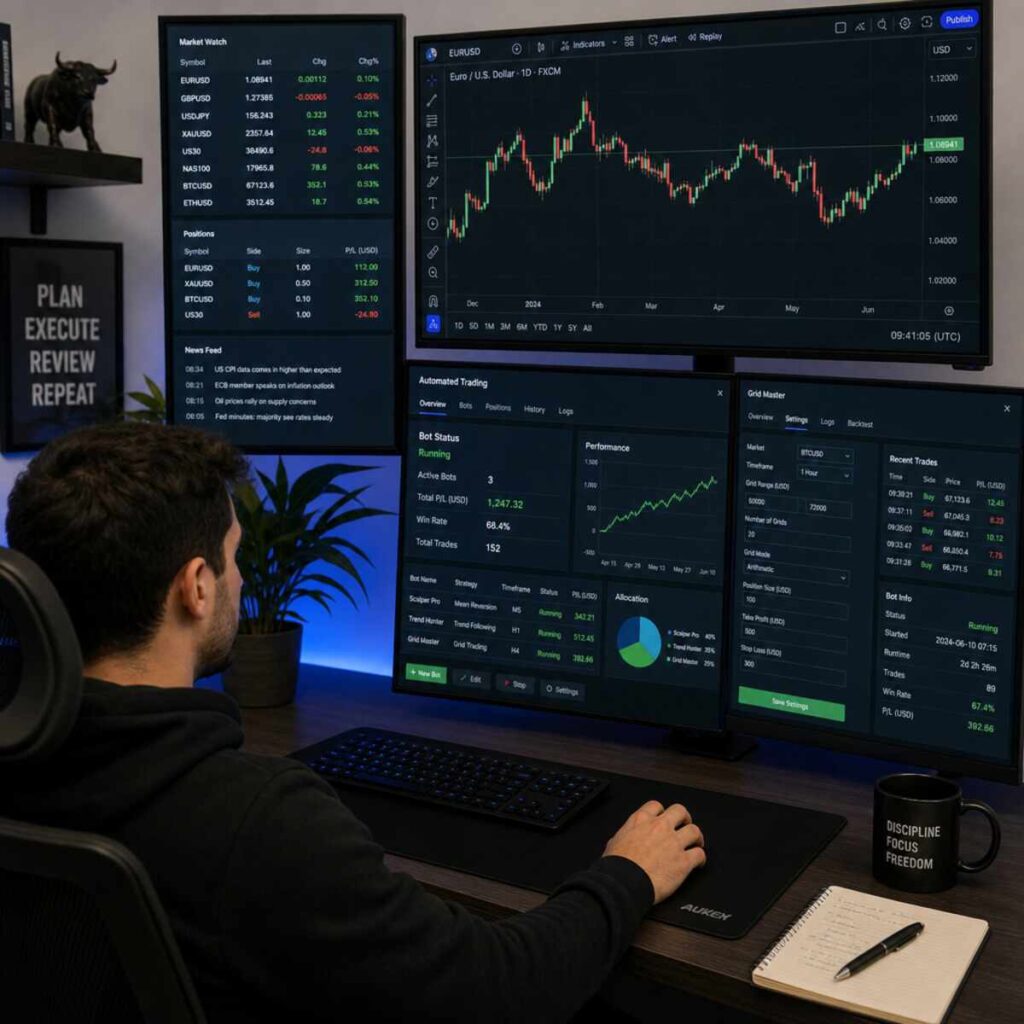
Imagine the financial markets of the 1980s: crowded trading floors, frantic shouting, hand signals, and paper tickets. Fast forward to today, and the chaotic shouting has been replaced by the quiet, relentless hum of computer servers. The modern financial market is dominated by machines, executing thousands of trades in the blink of an eye. For retail investors and independent traders, this technological revolution has opened the doors to a concept that was once reserved strictly for institutional giants: auto trading. What do you consider about UP.
If you have ever found yourself staring at charts until your eyes ache, missing out on a perfect setup because you stepped away to grab a coffee, or holding onto a losing position because you couldn’t bring yourself to hit the “close” button, you are not alone. These are universal challenges faced by manual traders. Automated solutions were born to solve exactly these problems.
By translating trading strategies into computer code, investors can now let software do the heavy lifting. In this comprehensive guide, we will unpack exactly how auto trading works, explore the technology that powers it, and provide actionable steps to help you start your journey into systematic trading safely and effectively.
What is Auto Trading?
At its core, auto trading (short for automated trading) is a method of participating in financial markets using a computer program that executes pre-set rules for entering and exiting trades. You, as the trader, define the strategy—the exact conditions that must be met to buy or sell an asset. The computer software then continuously monitors the market, and the moment those conditions are met, it executes the trade automatically.
This differs significantly from manual trading, where a human must physically observe the market, analyze the data, and click a button to execute a trade. Auto trading relies on automated execution systems to interact directly with market exchanges or brokers without requiring human intervention for each specific trade.
Auto Trading vs. Algorithmic Trading
While often used interchangeably, there is a nuanced difference between auto trading and algorithmic trading.
- Algorithmic trading refers to the use of complex mathematical models and formulas (algorithms) to make trading decisions. It is the “brain” determining what to trade, when to trade, and how much to trade.
- Auto trading specifically refers to the automation of the execution. You can have an algorithm that gives you buy/sell signals that you execute manually, or you can have an auto trading system that executes simple rules (like “buy when the price hits $100”) without complex math. However, modern automated platforms usually combine both: an algorithm makes the decision, and an automated system executes it.
The Evolution and Infrastructure of Systemic Trading
To truly understand how to implement these systems, you need to understand the underlying infrastructure. A trading bot doesn’t just exist in a vacuum; it requires a reliable pipeline to function.
The Role of APIs
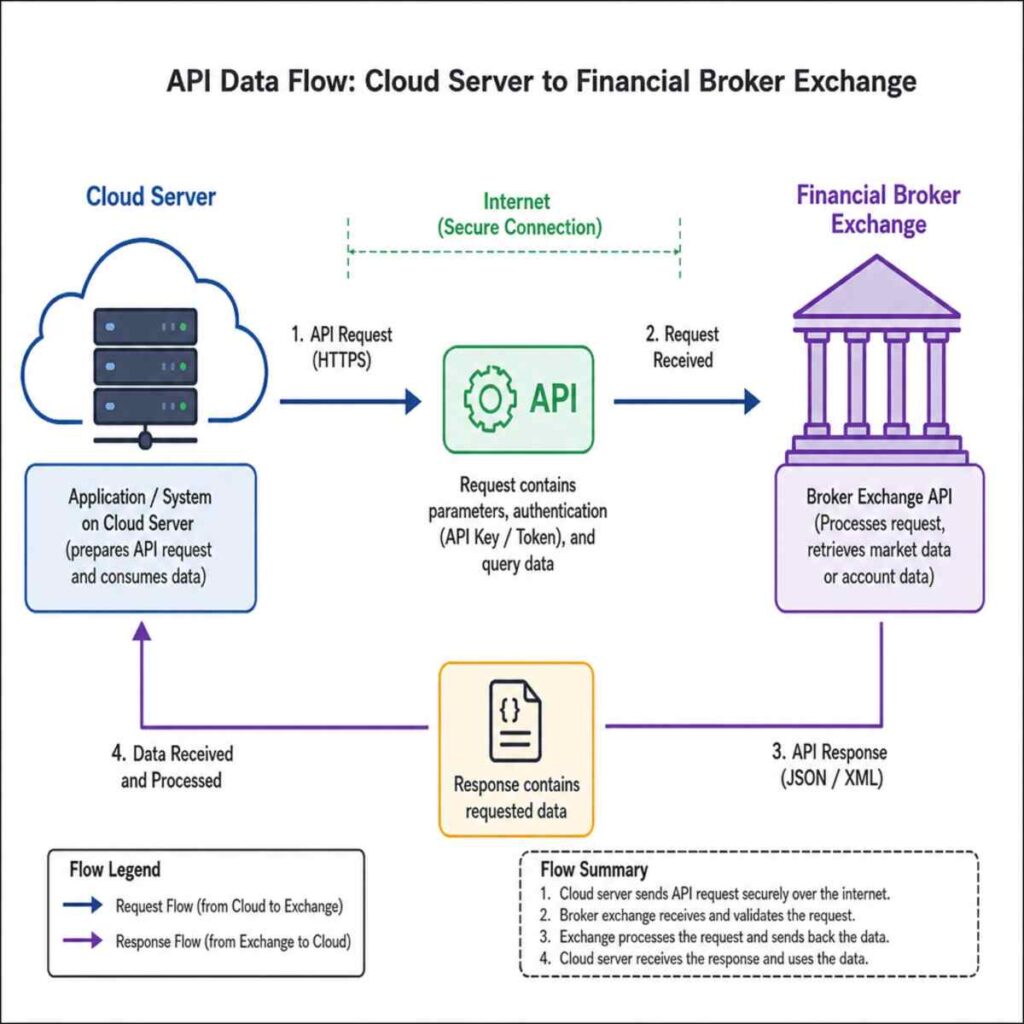
In the past, retail traders had to rely entirely on proprietary broker software that severely limited what they could automate. Today, the landscape has been revolutionized by APIs (Application Programming Interfaces). API integration for retail investors allows your custom software or third-party bots to communicate directly with your brokerage account.
Think of an API as a digital waiter. You (the bot) hand the waiter your order (the trade), the waiter takes it to the kitchen (the broker/exchange), and brings back your food (the trade confirmation). This seamless communication happens in milliseconds.
The Importance of Server Latency
When machines trade, speed is everything. A delay of half a second might mean the difference between a profitable entry and buying at the top of a spike. For institutional players utilizing high-frequency trading infrastructure, they literally physically locate their servers in the same building as the stock exchange to shave microseconds off their execution time.
While retail traders don’t need to spend millions co-locating servers, they do need to consider cloud-based trading server latency. Running a trading bot on your home computer is generally ill-advised. If your home Wi-Fi drops, your computer updates and restarts, or your power goes out, your bot goes offline. Instead, successful automated traders rent VPS (Virtual Private Server) hosting. A cloud-based VPS runs 24/7, boasts near-100% uptime, and can be situated geographically close to your broker’s servers to minimize latency.
How Trading Bots Work
The workhorses of the automated world are trading bots. A trading bot is simply a software application programmed to execute a specific trading strategy.
A bot operates on a continuous loop of three primary functions:
- Market Data Ingestion: The bot pulls real-time price feeds, volume data, and order book information from the exchange via the API.
- Strategy Evaluation: The bot runs this data through its programmed logic. It checks if the current market conditions match the criteria for a trade.
- Execution: If the criteria are met, the bot generates an order and sends it to the broker.
Developing Rule-Based Entry Signals
The hardest part of building a bot isn’t the coding; it’s defining the logic. To automate a strategy, it must be completely objective. You cannot program “gut feeling” or “buy when the chart looks bullish.” Computers only understand hard data.
Developing rule-based entry signals requires translating subjective market analysis into absolute mathematical conditions.
- Subjective: “I will buy when the trend reverses upwards.”
- Objective (Rule-Based): “I will execute a buy order when the 50-period Simple Moving Average crosses above the 200-period Simple Moving Average, AND the Relative Strength Index (RSI) is above 50, AND the current candlestick closes higher than the previous three.”
This rigid objectivity is what makes bots powerful, but it also means they are unforgiving. A bot will do exactly what you tell it to do, even if it results in catastrophic losses due to poorly defined rules.
The Psychological Edge of Automation
Perhaps the greatest advantage of using automated systems has nothing to do with speed or screen time; it has to do with human psychology.
Trading is intensely emotional. Fear of missing out (FOMO) causes traders to buy at the top. Fear of loss causes them to sell at the bottom. Greed causes them to hold onto winning trades too long until they turn into losers. Hope causes them to hold onto losing trades, praying the market will turn around.
Reducing emotional bias in finance is arguably the single most important step a trader can take toward consistent profitability. An automated bot does not feel fear, greed, or hope. It does not hesitate when an entry signal appears, and it does not stubbornly hold a position when its stop-loss criteria are met. It executes the plan with cold, calculating precision. By delegating the execution to a machine, you remove your own emotional sabotage from the equation.
Building Blocks: Algorithmic Strategies for Beginners
If you are new to the world of quantitative finance, stepping into algorithm creation can feel overwhelming. Fortunately, you don’t need a Ph.D. in mathematics to build a functional trading bot. Many successful automated systems are based on simple, time-tested market principles.
Here are three common algorithmic strategies for beginners that serve as excellent starting points for automation:
1. Trend Following (Moving Average Crossover)
This is the classic, bread-and-butter algorithmic strategy. It operates on the assumption that an asset in motion tends to stay in motion. The bot uses Moving Averages (which smooth out price data) to determine the trend.
- The Logic: The bot tracks a short-term moving average (e.g., 20 days) and a long-term moving average (e.g., 50 days).
- The Trigger: When the short-term average crosses above the long-term average, the bot buys (indicating an uptrend). When the short-term average crosses below the long-term average, it sells (indicating a downtrend).
2. Mean Reversion
Mean reversion is based on the idea that financial assets fluctuate, but eventually, return to their historical average price. If an asset drops too quickly, it is “oversold” and due for a bounce. If it rises too fast, it is “overbought” and due for a correction.
- The Logic: The bot uses an oscillator like Bollinger Bands or the RSI.
- The Trigger: If the asset’s price drops below the lower Bollinger Band, the bot places a buy order, expecting the price to revert to the moving average in the center.
3. Time-of-Day Breakouts
Markets often exhibit specific behaviors at specific times, such as the opening bell in the New York stock market or the overlap between the London and New York forex sessions.
- The Logic: The bot establishes the highest high and the lowest low of the trading session’s first hour.
- The Trigger: If the price breaks above the high of that first hour, the bot initiates a long (buy) position, anticipating a strong trend for the rest of the day.
A Practical Guide: Setting up Expert Advisors on MetaTrader
While many modern crypto platforms rely heavily on custom API scripts, the traditional retail forex and CFD markets are still largely dominated by MetaTrader 4 (MT4) and MetaTrader 5 (MT5).
In the MetaTrader ecosystem, trading bots are called Expert Advisors (EAs). Setting up Expert Advisors on MetaTrader is a surprisingly straightforward process, which is why it remains the go-to choice for millions of retail algorithmic traders.
Step-by-Step EA Installation:
- Acquire the EA: You can write your own EA using MetaQuotes Language (MQL4/MQL5), hire a freelance developer to code your strategy, or purchase a pre-built EA from the MetaTrader Market. EAs typically come as .ex4 or .ex5 files.
- Locate the Data Folder: Open your MetaTrader platform, click on File in the top left corner, and select Open Data Folder.
- Place the File: Navigate to the MQL4 (or MQL5) folder, then open the Experts folder. Drag and drop your .ex4 or .ex5 file into this folder.
- Refresh the Platform: Go back to your MetaTrader terminal. Open the Navigator panel (usually on the left side). Right-click on the Expert Advisors tab and select Refresh. Your new bot should now appear in the list.
- Enable Auto Trading: Before the bot can trade, you must give the platform permission. Click the AutoTrading button on the top toolbar so that it shows a green “play” icon.
- Attach to Chart: Drag the EA from the Navigator panel onto the chart of the asset you wish to trade. A settings box will pop up, allowing you to tweak the bot’s parameters (like lot size, stop loss distance, and risk percentage) before clicking OK. A smiley face in the top right corner of the chart confirms your EA is active and ready to trade.
The Golden Rule: How to Backtest Trading Bots
If there is one cardinal sin in automated trading, it is deploying a bot with real money before thoroughly testing it. Because a bot trades without hesitation, a flawed algorithm can drain your entire account while you sleep.
Backtesting is the process of simulating a trading strategy using past market data to see how it would have performed. Understanding how to backtest trading bots correctly is what separates professional algorithmic traders from gamblers.
The Phases of Testing
1. Acquiring Quality Data The accuracy of a backtest is only as good as the data it uses. “Garbage in, garbage out.” Evaluating historical performance data requires high-quality, tick-by-tick market data. Many platforms offer free historical data, but it often has gaps or errors. Serious algorithmic traders purchase premium historical data to ensure their backtests mirror reality.
2. In-Sample vs. Out-of-Sample Testing When evaluating historical performance data, you must split your data into two chunks.
- In-Sample Data: This is the data you use to build and optimize your bot. Let’s say you use data from 2018 to 2021 to tweak your moving average lengths until they produce maximum profit.
- Out-of-Sample Data: Once the bot is optimized, you must test it on data it has never seen before (e.g., data from 2022 to 2023). If the bot performs well in-sample but fails miserably out-of-sample, you have “over-optimized” or “curve-fitted” the bot. It memorized the past but cannot predict the future.
3. Forward Testing (Paper Trading) Even a perfect backtest cannot account for real-world variables like slippage (the difference between expected price and actual execution price), spread widening during news events, or temporary broker disconnections.
Forward testing involves running the bot live, in real-time, but with fake money (a demo account). You should run your bot in a simulated live environment for several weeks or months to ensure it behaves exactly as it did in the backtest before ever risking real capital.
Protecting Your Capital: Risk Management in Programmatic Trading
A highly profitable entry strategy is useless without an ironclad risk management protocol. In manual trading, you can adjust on the fly if a trade goes against you. In auto trading, your risk parameters must be hard-coded.
Risk management in programmatic trading focuses on survival. Markets can act irrationally, experiencing “flash crashes” or massive spikes due to geopolitical news. Your bot must be equipped to handle these “Black Swan” events.
Essential Risk Parameters to Code:
- Dynamic Position Sizing: Never hard-code a static dollar amount or lot size. Instead, program the bot to calculate position size as a percentage of your current account equity. If you stipulate a 1% risk per trade, the bot will automatically buy fewer shares/contracts if your account balance drops, slowing down the rate of loss during a losing streak.
- Hard Stop Losses: Every single order your bot sends to the market must be accompanied by a stop-loss order. If the exchange goes offline or the API connection drops while you are in a trade, a server-side stop loss will protect you from a total margin call.
- Daily Drawdown Limits (Circuit Breakers): Just as major stock exchanges have circuit breakers that halt trading during a crash, your bot should have an internal kill switch. You can program a rule: “If total equity drops by 5% in a single 24-hour period, close all open positions and suspend trading until tomorrow.” This prevents a malfunctioning bot from burning through your account in a single afternoon.
Automated Alternatives: Copy Trading vs. Automated Software
Building, testing, and managing a trading bot requires a significant investment of time, technical skill, and financial education. For many retail investors, this barrier to entry is simply too high. Fortunately, the fintech industry has developed alternative routes to automated market participation.
This brings us to the debate of copy trading vs automated software.
Copy Trading Explained
Copy trading (or mirror trading) allows you to automatically copy the real-time trades of an experienced, successful human trader. When they click “buy” in their account, your account automatically buys the same asset in proportion to your account size.
The rise of social trading platforms for passive income, such as eToro, ZuluTrade, and specialized broker features, has democratized access to professional trading strategies.
Pros of Copy Trading:
- Zero Coding Required: You simply browse a leaderboard of traders, review their historical performance data, and click “copy.”
- Human Intuition: You benefit from a human’s ability to interpret nuanced fundamental news (like a sudden political event) that a rigid bot might fail to understand.
- Truly Passive: Once set up, it requires minimal daily management.
Cons of Copy Trading:
- Human Error: You are still subject to the human trader’s emotional lapses, revenge trading, or fatigue.
- Hidden Risks: A copy trader might have a great win rate because they use risky strategies like the Martingale system (doubling down on losing trades), which can lead to catastrophic account blowouts.
Custom Automated Software Explained
This is the path we have detailed throughout this guide—building or buying an algorithm that executes trades on your behalf.
Pros of Automated Software:
- Total Control: You know exactly what the logic is. There are no surprises.
- Speed and Frequency: Bots can execute trades on tick-data and manage hundreds of micro-transactions a day, something a human copy trader physically cannot do.
- Emotionless: It completely removes human bias from the execution phase.
Cons of Automated Software:
- High Maintenance: Financial markets are dynamic; a strategy that worked perfectly in a bull market may bleed money in a ranging market. Bots require constant monitoring, tweaking, and re-optimization.
- Technical Failures: You are responsible for server maintenance, API connections, and software updates.
In summary, copy trading is ideal for those seeking a hands-off, passive approach, while custom automated software is suited for analytical individuals who want total control over their execution infrastructure.
Beware the Hype: Common Pitfalls of Black Box Algorithms
If you venture into the auto trading space, you will quickly be targeted by advertisements promising “Guaranteed 100% Monthly Returns” using proprietary, secret trading bots. These are known as “Black Box” algorithms.
A black box system is one where the creator sells you the bot, but hides the internal logic. They tell you what the bot does (makes money), but not how it decides to trade.
Relying on these systems is one of the most dangerous things a retail investor can do. The common pitfalls of black box algorithms are numerous:
- Inability to Intervene: If the market conditions change and the bot starts losing heavily, you don’t know why it’s losing, so you don’t know if you should turn it off or let it ride out the storm.
- Scam Potential: Many commercial black box bots are over-optimized to look brilliant on past historical data but are mathematically doomed to fail in live, out-of-sample market conditions.
- Dangerous Risk Profiles: To achieve high marketing win rates, many black box EAs utilize highly dangerous risk management styles, such as wide or non-existent stop losses, or grid trading. They generate small, consistent profits for months, only to lose everything in a single, unpredicted market swing.
As a general rule, never automate your capital using a strategy that you cannot understand and explain in plain English.
The Legal Landscape and Ethical Considerations
A common question among beginners is whether using software to trade the markets is actually allowed. The short answer is yes. However, understanding the legality of trading scripts in financial markets requires looking at specific jurisdictions and broker agreements.
In almost all major financial markets (the US, UK, EU, Australia), algorithmic trading is entirely legal. In fact, on major exchanges like the NASDAQ or the New York Stock Exchange, the vast majority of daily volume is driven by institutional algorithms.
However, “legal” does not mean “unregulated.”
- Broker Restrictions: While it is legal by law, individual brokers have their own Terms of Service. Some brokers prohibit “toxic” trading strategies. For instance, high-frequency “scalping” bots that open and close trades in fractions of a second to capture microscopic spread differences put immense strain on a broker’s servers. Many retail brokers explicitly forbid sub-second scalping bots.
- Arbitrage and Latency Exploitation: Using bots to exploit latency differences between a broker’s price feed and the underlying market feed (latency arbitrage) is almost universally banned by retail brokers. If caught, the broker will likely cancel your profits and ban your account.
- Market Manipulation: Programming a bot to engage in “spoofing”—placing massive fake orders to manipulate the price of an asset with no intention of executing them—is a severe criminal offense investigated by agencies like the SEC (Securities and Exchange Commission) and the CFTC (Commodity Futures Trading Commission).
Always read your broker’s policy on automated trading before deploying your script, and ensure your algorithm is designed to trade the market fairly, not manipulate it.
The Future of Auto Trading: AI and Machine Learning
The landscape of auto trading is constantly evolving. We are currently moving from rigid, rule-based algorithmic trading to dynamic, AI-driven models.
Traditional bots are static; if you program them to buy on a moving average crossover, that is all they will ever do. Today, institutional funds are heavily utilizing Machine Learning (ML). These advanced algorithms ingest massive amounts of unstructured data—from price charts to social media sentiment and global news feeds—and continuously rewrite their own trading rules based on what is currently working in the market.
While creating true AI-driven deep learning models is still largely beyond the scope of the average retail investor, tools are rapidly becoming democratized. Platforms are emerging that allow traders to train simple machine learning models using visual, drag-and-drop interfaces without needing to write complex Python code. As this technology trickles down, the gap between retail and institutional algorithmic capabilities will continue to shrink.
Conclusion
Stepping into the world of auto trading is akin to transitioning from driving a manual car to managing a fleet of autonomous vehicles. It shifts your role from being the executor to being the architect.
By utilizing APIs and cloud computing, you can build systems that operate with lightning speed. By developing clear, mathematical entry rules, you strip away the emotional turmoil that ruins so many manual traders. Whether you choose to code your own algorithms, set up Expert Advisors on MetaTrader, or leverage social copy trading platforms, the goal remains the same: to interact with the financial markets systematically, safely, and efficiently.
However, automation is not a magical money-printing machine. It requires rigorous backtesting, strict risk management, and constant vigilance to prevent algorithms from turning rogue in volatile markets. If you approach auto trading with patience, a dedication to data over emotion, and an insistence on understanding every line of logic your bot executes, it can become an incredibly powerful tool in your financial arsenal.
Take your time, test heavily in demo environments, and never risk capital you cannot afford to lose. The markets will always be there, and your bots can patiently wait for the perfect moment to strike.