
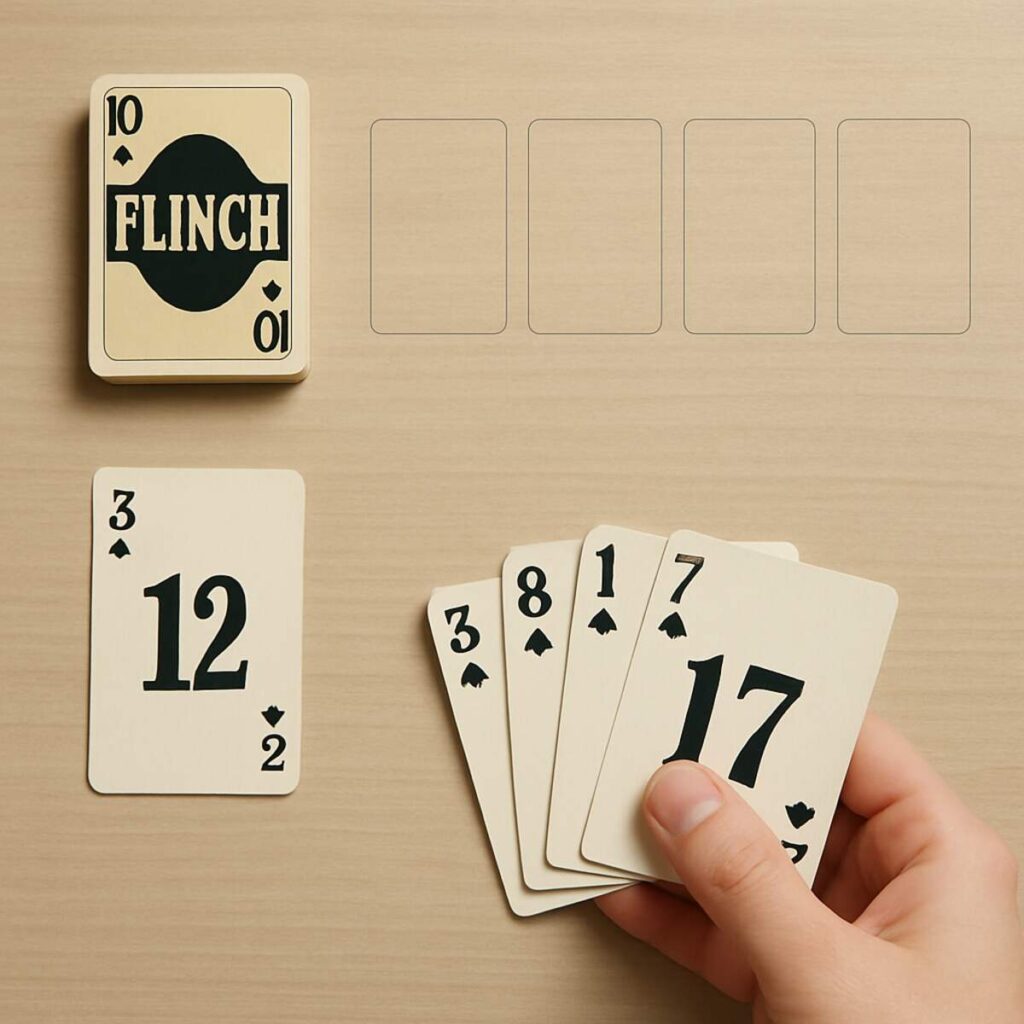
Did you just find an old, colorful box of Flinch cards in the attic or at a thrift store? You’ve stumbled upon a fast-paced classic that might look a little confusing at first with all its numbers. Don’t worry. This guide will get you from opening that vintage Flinch card game box to playing your first round in under 10 minutes. Check out UFAC4 to know more
Despite the various piles of cards that will soon cover your table, the entire game boils down to a single, simple mission. The only goal is to be the first player to play every card from your main 10-card Stock Pile. Think of it like the stack you’re trying to clear in a game of Solitaire—once that personal pile is empty, you’ve won the game.
This straightforward objective is what has made the Flinch card game a family favorite for over a century. The rules are simple enough for kids to grasp quickly, yet the rapid pace of play keeps players of all ages on the edge of their seats. You don’t need a mind for complex strategy, just a sharp eye for numbers and quick hands to spot your next move before someone else does.
By the end of this guide, you’ll be playing with the confidence of a seasoned player and adding a new classic to your game night rotation.
The First Step to Winning: Setting Up Your Flinch Game Correctly
Before you can jump into the action, you need to get the game set up. The first thing you’ll notice about Flinch is the unique deck—it contains 150 cards, made up of ten full sets of cards numbered 1 through 15. Your first job is simply to give this entire deck a thorough shuffle to mix up all those numbers.
With the deck shuffled, you’re ready to deal. Following these setup rules is the key to a smooth game, so take your time with these steps for each player:
- Deal each player a pile of 10 cards, face-down. This is their personal Stock Pile. The goal is to be the first person to play all the cards from this pile.
- Next, each player turns the top card of their own Stock Pile face-up, leaving it on top of the pile. This card is now available to be played.
- Finally, deal 5 more cards to each player to form their starting Hand. Players can look at the cards in their hand, but should keep them hidden from others.
Once everyone has their cards, place the large remaining stack of cards face-down in the center of the table to form the draw pile. At this point, each player should have their Stock Pile (with one card showing) in front of them and their 5-card Hand. The rest of the table is left open for the action to begin.
What Are All These Piles? The Four Zones of Flinch Explained
As a game of Flinch gets going, the table can start to look like a mess of cards, but it’s actually very organized. Understanding the four distinct zones where cards can be is the secret to making the game click. Think of the table as being divided into your personal areas and a shared area in the middle.
Every card in play lives in one of these four spots. Here’s what they are and what they do:
- Stock Pile: You already know this one! It’s your personal pile of 10 cards, and your goal is to empty it to win the game. Only the top card is face-up and available to play.
- Hand: These are the five cards you hold and look at. You use cards from your hand to make plays or start your personal Reserve Piles.
- Reserve Piles: These are your personal discard piles that you create during the game. You can have up to five of them in front of you. They’re a great way to get unplayable cards out of your hand and set them aside for a future turn. Any face-up card on a Reserve Pile is available to be played.
- Play Piles: These are the shared stacks in the center of the table that everyone plays on. A Play Pile can only be started with a “1” card. From there, players build on it in sequence (2, 3, 4…) all the way up to 15.
Essentially, your goal is to move cards from your Stock Pile, Hand, and Reserve Piles onto those central Play Piles whenever you have the right number. Now that you know the layout, you’re ready for the turn-by-turn action.
How to Take a Turn: The Simple 3-Step Flinch Gameplay Loop
The Flinch gameplay loop is a simple, repeating process. Your turn always begins by making sure you have five cards in your hand. If you have fewer because you discarded one to end your last turn, you’ll first draw from the main deck until you’re back up to a full hand of five.
With a full hand, you’re ready to play. Look for opportunities to add cards sequentially to the shared Play Piles in the center. Unlike games where you play just one card, a key part of the Flinch game rules is that you can play as many cards as you legally can in one continuous chain. Making long plays is one of the most effective tips for winning at Flinch because it clears your piles out so quickly.
When you’ve made all possible plays or simply can’t find one, you must end your turn. To do this, choose one card from your hand and place it face-up onto one of your personal Reserve Piles (you can start a new pile if you have fewer than five). This action concludes your turn and signals the next player to begin. But when you’re making those plays, where do the cards come from? You have three options.
Where Can You Play From? Your 3 Sources for Making Plays
When it’s your turn to make a play, you aren’t limited to just the cards in your hand. Flinch gives you three different places to look for the next number in a sequence. You can play the face-up top card of your Stock Pile, any of the five cards from your Hand, or the top card of any of your personal Reserve Piles. This flexibility means you should always scan all of your available cards before deciding you have no moves. A single turn can involve playing cards from all three sources, one after the other.
Of all these options, your Stock Pile is king. Since the entire goal of the game is to get rid of the cards in that pile, playing from it should always be your top priority. This is the single most important piece of Flinch card game strategy: if you can make a legal play using the top card of your Stock Pile, you should do it. Every card you remove from it is a step closer to victory, and playing from your Hand or Reserves is often just a way to clear a path for that crucial Stock Pile card.
This all comes together in the form of “chaining plays.” Imagine the top card of your Stock Pile is an ‘8’, and there is a ‘7’ in a center Play Pile. You play your ‘8’, revealing a new card—a ‘4’—on top of your Stock Pile. You look again and see a ‘3’ in a different Play Pile. Perfect! You play your ‘4’ on it. Now, you notice a ‘5’ in your hand that you can also play. In one quick sequence, you played from your Stock Pile twice and your Hand once. This core concept of prioritizing and chaining plays leads directly to the game’s most famous rule.
The “Flinch!” Rule: How to Penalize an Opponent’s Mistake
Now for the rule that gives the game its name! Because playing from your Stock Pile is so important, there’s a penalty for forgetting to do so. If it is your turn and you miss a chance to play the top card of your Stock Pile, any other player can immediately shout “Flinch!” This rule is very specific: it only applies when you could have played from your Stock Pile but didn’t, not from your hand or reserves. You are never penalized for choosing not to play a card from your hand.
So what happens when someone correctly calls you out? The penalty is a setback. You must immediately stop your turn, draw one card from the center draw pile, and place it at the very bottom of your Stock Pile. This makes your primary pile one card larger, pushing victory a little further away. This is one of the core Flinch game rules for beginners to learn, as it ensures all players are paying close attention to every move, not just their own.
Any player can call “Flinch!” at any time, turning the whole table into watchful hawks. If the call is correct, the player who missed their move takes their penalty card and their turn ends right there. But a true lack of moves isn’t a Flinch; it’s a different situation entirely.
Stuck With No Moves? How to End Your Turn and Build Your Reserves
It’s inevitable: sometimes it will be your turn, and after scanning every possible option, you’ll find you have no legal plays. You can’t play from your Stock Pile, your hand, or any of your reserves. When this happens, you don’t just pass. To end your turn, you must choose one card from your hand and place it face-up in front of you. This starts one of your personal Reserve Piles. If you already have Reserve Piles, you simply place a card from your hand on top of any one of them.
These personal discard piles are your secret weapon. You can have up to five of them, creating new ones as you need them. The top card of each Reserve Pile is available for you to play on a future turn, just like a card from your hand. This is the solution to the what to do when you get stuck in Flinch dilemma—turning a dead end into a future opportunity. These piles become a crucial extension of your hand, holding cards you can’t use now but might need very soon.
This is where a bit of Flinch card game strategy comes into play. Since you choose which card to discard, you can be clever about it. For example, if you have a ‘7’ and an ‘8’ in your hand, you might place the ‘8’ down first, then the ‘7’ on top of it on your next turn. Later, if you play that ‘7’, the ‘8’ is immediately available to be played next. Smartly organizing your Reserve Piles is one of the key Flinch hand and stockpile rules that separates a beginner from a savvy player, turning a simple discard into a powerful setup for your next turn.
From Beginner to Winner: 3 Simple Tips to Gain an Edge in Flinch
Once you’ve mastered the basic flow, you can start playing to win. Winning at Flinch isn’t about pure luck; it’s about making smarter choices. With just a few simple shifts in your thinking, you can apply some basic Flinch card game strategy to gain a significant edge over your opponents.
The absolute golden rule is to prioritize your Stock Pile. Always. If you have a choice between playing the same number card from your hand or your Stock Pile, play from the Stock Pile every time. Remember, the game only ends when someone empties their Stock Pile. Playing a card from your hand just frees up your hand for a moment, but playing a card from your Stock Pile gets you one concrete step closer to victory.
Your next focus should be organizing your Reserve Piles. When you discard a card to end your turn, don’t just throw down anything. Try to stack cards in descending order. For instance, if you have a ‘6’ in a reserve pile, placing a ‘5’ on top of it on your next turn sets you up for a powerful combo later. The moment you play that ‘5’, the needed ‘6’ is immediately ready to go.
Finally, start paying attention to your opponents’ Stock Piles. If you see the player to your left has a ‘9’ sitting on top of their pile, you should think twice before playing a ‘7’ and then an ‘8’ that would directly help them. These are some of the best tips for winning at Flinch because they involve a bit of defensive play. Sometimes, the best move is holding back a card that gives an opponent a clear path to play their key card. This opponent awareness is a major part of the fun and a key difference when comparing Flinch to similar games like Skip-Bo.
Is Flinch Just Like Skip-Bo? The 3 Key Differences You Need to Know
If you’ve played Skip-Bo, the setup for Flinch probably feels very familiar. Many players consider them to be similar card games, and it’s true that Skip-Bo was heavily inspired by its century-old predecessor. However, knowing the key differences in the Flinch vs Skip-Bo rules is essential to playing the vintage game correctly. The distinctions create a unique rhythm and strategy all their own.
While both games involve emptying a stock pile by sequencing cards, three critical differences change how you play:
- The Piles: In Skip-Bo, your four discard piles are mostly for storage; you can only play the top card. In Flinch, your five Reserve Piles are fully active. You can play any exposed card from these piles, not just the top one, opening up far more strategic possibilities on your turn.
- The Deck: Flinch uses a deck of cards numbered 1-15. There are no wild cards. Skip-Bo, on the other hand, uses a 1-12 deck and includes powerful “Skip-Bo” cards that act as wilds, which can save a stalled turn.
- The Penalty: Flinch has its signature “Flinch!” rule. If you miss a valid play from your Stock Pile, an opponent can call you out, forcing you to take a penalty card. Skip-Bo has no equivalent rule, making Flinch a game that demands more attention.
Your Flinch Questions Answered: 2-Player Games, Scoring, and More
One of the best things about Flinch is its flexibility. Wondering if you can play Flinch with 2 players? Absolutely. The game works brilliantly with anywhere from two to eight people, and the core rules don’t change at all. The only difference you’ll notice is the pacing—a head-to-head two-player game is a tense, strategic duel, while a large eight-player game is a chaotic and hilarious race where you have to watch everyone at once.
As the game heats up, you’ll see the center Play Piles grow quickly. Once a pile is built up sequentially and reaches a ’15’ card, its journey is over. Simply take that completed stack of 15 cards and set it aside. This frees up a spot in the middle of the table, allowing any player with a ‘1’ card to start a brand new Play Pile on their turn and keep the action flowing.
So, how do you determine a champion? The official Flinch card game scoring method, reflecting the game’s deep roots, awards the round’s winner 10 points while other players get 1 point for each card in their own completed piles. In reality, most families and friends play for the simple thrill of the win. Today, the most common way to play is that the first person to empty their Stock Pile is the victor—no math required!
Given the Flinch card game history spans over a century, you may encounter different Flinch card game variations as house rules. Some families have unique penalty rules or change the number of cards in the Stock Pile. For your first few rounds, it’s best to stick to the basics outlined here to get a feel for the game.
Flinch Quick Guide: A 60-Second Recap
What might have looked like a confusing box of numbered cards is now a game you’re ready to play. You have all the rules you need to guide your friends and family through a complete round, from the first “1” played to the final card that wins the game.
Here is a quick summary to reference during your first few turns:
- Goal: Be the first player to empty your 10-card Stock Pile.
- Setup: Deal 10 cards to each player’s Stock Pile and 5 cards to their Hand.
- Your Turn: Draw until you have 5 cards, play any legal cards, then end your turn by discarding one card to a personal Reserve Pile.
- How to Play: Build shared Play Piles in the center by playing cards in sequence from 1 to 15, using cards from your Stock Pile, Hand, or Reserve Piles.
- How to Win: The moment you play the last card from your Stock Pile, you win!
Remember, the secret to winning Flinch isn’t just playing cards—it’s playing the right cards. Always prioritize playing the top card of your Stock Pile whenever you can. After a few rounds, the rhythm of drawing, playing, and discarding will become second nature. Have fun adding a new classic to your game night rotation!