
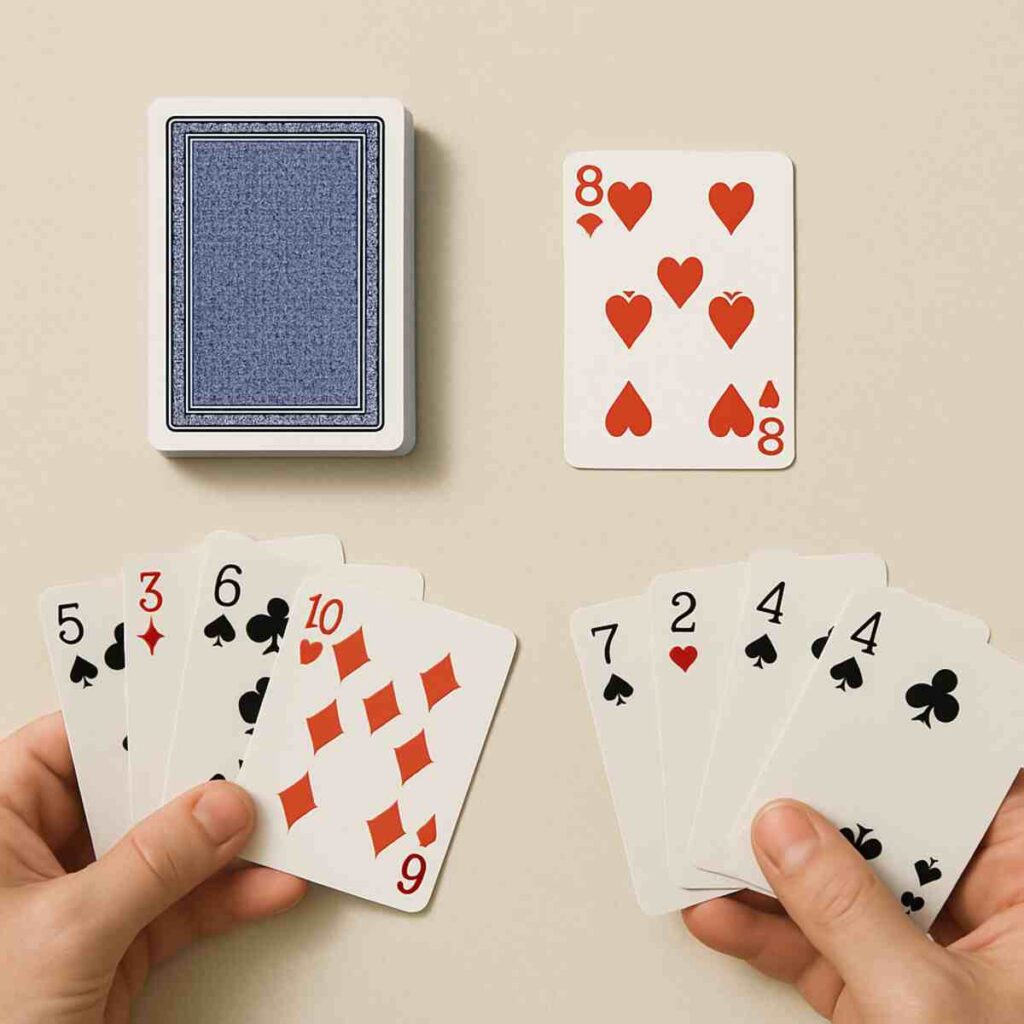
If you’ve ever played a card game like Uno, you already understand the core idea behind the Crazy Eights card game. It’s a fast-paced, shedding-type game built on a simple matching principle, but with a few exciting twists that have made it a staple of family game nights for generations. The game is easy to learn in a few minutes but stays fun for hours. Check out gamestopgiftbalance.com to know more
The beauty of this classic is its accessibility. You don’t need special equipment or complicated scoring sheets; a standard 52-card deck is all you require. For anyone learning to play, the barrier to entry is just the time it takes to find a deck and shuffle it.
Your objective is wonderfully straightforward: be the first player to get rid of all the cards in your hand. Every rule, from matching suits and numbers to playing the powerful “Crazy Eights,” is built around this single goal.
How to Set Up and Deal for Any Number of Players
Getting started is simple. All you need is a standard 52-card deck and at least one other person. The dealer shuffles the deck and hands out cards one at a time, face-down, to each player. The number of cards dealt depends on how many people are playing:
- 2 Players: Deal 7 cards each.
- 3-4 Players: Deal 5 cards each.
- 5+ Players: It’s best to shuffle two decks together and deal 5 cards each.
Once the hands are dealt, place the rest of the deck face-down in the center of the table. This is your draw pile. To start the game, take the top card from the draw pile and place it face-up right next to it. This single, face-up card creates the discard pile, which players will play on top of.
If that first card you flip over is a Crazy Eight, don’t start the game with a wild card in play. Simply place the 8 somewhere in the middle of the draw pile and flip over the next card to begin. This ensures the first player has a normal turn.
With cards in everyone’s hands and the piles ready, the setup is complete. The player to the left of the dealer goes first.
Your First Turn: The Core Rule of Matching by Suit or Rank
Your turn is your chance to get one card closer to victory. To do this, you must play a card from your hand that matches the card sitting face-up on the discard pile. A legal play must match the previous card’s suit (the symbol, like Hearts or Spades) or its rank (the number or face, like a 7 or a King).
For example, if the top card of the discard pile is a 10 of Diamonds, you have two options. You could play any other Diamond from your hand, regardless of its number. Alternatively, you could play a 10 of any other suit—a 10 of Clubs, Hearts, or Spades would all be valid plays.
Thinking through your options is the core of the game. If the discard pile shows a Jack of Hearts, scan your hand for any Heart or any other Jack. Choosing which one to play is the most basic strategy, as you might want to save certain cards for later. But what happens when you look at your hand and realize you have no card that matches by either suit or rank? In that case, it’s time to visit the draw pile.
What to Do If You Can’t Play a Card
It’s a moment every player faces: you stare at your hand, and nothing matches the discard pile. When this happens, the rules are simple: you must draw the top card from the draw pile and add it to your hand.
Take a look at the new card you just picked up. If it happens to be a legal match for the card on the discard pile, you’re in luck! You can play it immediately on that same turn. For instance, if the discard pile is a 4 of Spades and you draw a 4 of Hearts, you can place it right down, completing your turn.
However, if the card you just drew is also unplayable, your turn simply ends. You keep the new card, increasing the size of your hand, and play passes to the person on your left. While holding more cards isn’t ideal, sometimes you just have to wait for the right card to come along. Of course, one special card can almost always get you out of a jam.
The Power of the ‘Crazy Eight’: How to Use the Ultimate Wild Card
The ‘Crazy Eight’ is the most important card in the deck and the reason the game gets its name. Mastering its unique function is key to mastering the game’s flow and its special card rules.
An 8 is considered a wild card, which means you can play it on your turn on top of any other card in the discard pile—it doesn’t matter what the suit or number is. If the pile shows a 7 of Spades and you have no other Spades or 7s, you can still play your 8 of Clubs to complete your turn.
Playing an 8 isn’t the final step. Immediately after you place it on the discard pile, you must declare a new suit. For example, if you play an 8, you can say aloud, “The new suit is Hearts.” The next player is now required to play a card of that suit (in this case, any Heart) or play another 8.
This ability to change the suit on command is your ultimate tool for taking control. If your hand is full of Diamonds, you can play an 8 and switch the game to Diamonds, forcing opponents to draw if they don’t have any. But the 8 isn’t the only card with a game-changing ability.
How to Use Special Cards to Disrupt Your Opponents
While the 8 is the star, several other cards have special powers that can instantly turn the tables. These action cards are a key part of the special card rules and are your primary tools for disrupting the flow of the game. If you’ve played other shedding card games like Uno, these effects will feel very familiar. The most common power cards are Twos, Queens, and Aces.
Each of these cards has a specific job designed to hinder the next player. You can only play them if they match the suit or rank of the top card on the discard pile. Their special effects are:
- Twos: The next player must draw two cards from the draw pile and forfeits their turn.
- Queens: Skips the next player’s turn, giving you a small but powerful advantage.
- Ace: Reverses the direction of play. If the play was moving clockwise, it now moves counterclockwise (and vice-versa).
To see how to use them, imagine the top card is a 10 of Spades. You play your 2 of Spades. The player after you now has to stop, draw two cards, and miss their turn completely. This not only burdens them with more cards but also buys you time. Likewise, playing a Queen to skip a player who only has one card left can be a game-winning move.
From Novice to Winner: 3 Basic Strategies to Win at Crazy Eights
Knowing the rules is one thing, but developing a basic strategy is what separates a lucky player from a consistently good one. It starts by understanding that the cards left in your hand at the end of a round often count against you. In many versions, a scoring system assigns penalty points for each card you’re holding when someone else goes out. This concept, known as point liability, is central to smart play.
Your priority should be to get rid of your highest-value cards as soon as you legally can. If you’re holding a King, Queen, and a 3 that could all be played, it’s almost always better to discard the King. Getting that 10-point liability out of your hand early protects you from getting stuck with it if another player suddenly wins.
While it’s smart to shed high-point cards, the Crazy Eight is the major exception. An 8 is your ultimate escape plan. Holding onto it gives you a guaranteed play on any turn, which is invaluable when you’re stuck. The best time to play your 8 is either to save yourself from drawing or, more powerfully, to change the suit to something you know an opponent (especially one with few cards left) doesn’t have.
Finally, an underrated strategy has nothing to do with the cards in your hand, but everything to do with the ones in your opponents’. Pay attention. Did the player to your right just draw three times when Hearts was the active suit? You now have a critical piece of information: they likely have no Hearts. Later, if you play an 8, you know exactly which suit to call to put them in a tough spot. Watching what others can’t play is just as important as knowing what you can.
Down to One Card: How to Legally Win the Game
The most exciting moment in Crazy Eights is when you’re about to play your second-to-last card. As you place it on the discard pile, many players follow a popular house rule: you must announce “last card” to the table. This signals to everyone else that you are one play away from victory, giving them a final turn to try and stop you.
Forgetting to announce your last card usually comes with a penalty. If another player catches your mistake before your next turn begins, you typically have to draw one or two cards from the draw pile. This rule keeps players on their toes and adds a fun layer of social awareness to the game’s final moments.
A frequent question is whether you can play a special card to win the game. The answer is almost always yes. Playing a 2 as your last card not only wins you the round but also forces the next player to draw two cards, adding to their point total. Similarly, you can absolutely end a game on a wild card like an 8. You simply play the 8, and you win instantly without even needing to name a new suit.
Because so many people play with slight variations, it’s always a good idea to quickly confirm the “last card” and “special card win” rules before starting a game with a new group. This simple check ensures everyone is on the same page.
Is Crazy Eights Just Uno with a Different Deck?
If you’ve been thinking that Crazy Eights sounds a lot like Uno, you’re not wrong. Its DNA is clearly visible in other popular shedding-type card games. Both share the objective of being the first player to empty your hand, but the two games have key differences that give each its own feel.
The most significant difference is the deck itself. The greatest strength of Crazy Eights is its accessibility; you can play it with any standard 52-card deck. Uno, on the other hand, is a proprietary game that requires its own special deck. This makes Crazy Eights a timeless public domain classic, while Uno is a specific commercial product.
Beyond the deck, the games handle their “power cards” differently. In Crazy Eights, certain ranks like 2s or Queens are assigned special functions. In Uno, these actions are given to dedicated cards like “Draw Two,” “Skip,” and “Reverse.” Wild cards also function with a slight variation. After playing a Crazy Eight, you declare a new suit. When playing a Wild card in Uno, the card itself is simply considered to be the new color you choose.
Think of Crazy Eights as the flexible, classic ancestor of many modern shedding games. Uno took the core concept, streamlined it with custom-designed cards, and packaged it for a mass audience. The original’s use of a standard deck, however, leaves it open to countless variations and house rules, which is a huge part of its lasting appeal.
Taking It Further: How to Score a Game and Add Fun House Rules
Winning a single round is fun, but playing multiple rounds with a scoring system can find an overall champion. The most common scoring system is simple: when a player goes out, the other players add up the value of the cards left in their hands. These are penalty points, so the goal is to have the lowest score at the end of the game.
Here is a popular set of values for the cards left in a player’s hand:
- Number Cards (2-10): Face Value
- Face Cards (J, Q, K): 10 points
- Aces: 1 point
- Crazy Eights: 50 points
Beyond scoring, the real magic of Crazy Eights lies in its flexibility. Because it uses a standard deck, it’s the perfect game for creating your own variations and house rules. For example, a popular house rule involves stacking power cards. Instead of just accepting your fate when someone plays a Draw Two, a stacking rule lets you fight back. If the player before you plays a 2 of Hearts, you could play a 2 of Spades on top of it. Now, the next person in line has to draw four cards! This can create wild, memorable moments.
You’re Ready for Game Night
You now have all the rules to transform a simple deck of cards into an evening of fun. As you begin your first game, remember the simple rhythm of every turn: try to match the top card by suit or rank, and draw from the pile if you can’t. Use your special cards wisely to be the first to empty your hand.
The rules are your foundation, but the real excitement comes from surprising comebacks and shared laughter. Grab a deck of cards, gather some friends, and play your first game.