
Found an old Flinch box in the attic and have no idea how to play? You’re holding a 100-year-old classic that’s surprisingly easy to learn. The most important first step is understanding the Flinch card piles and layout. Once you know where everything goes, the rules will click into place instantly. Check out Soju88 to know more
First, a Flinch deck is different from a standard poker deck. It contains 150 cards, made up of ten complete sets of cards numbered 1 through 15. Your primary goal is simple: be the first player to play all the cards from a special 10-card stack. To do that, you need to know the four key zones that make up the game.
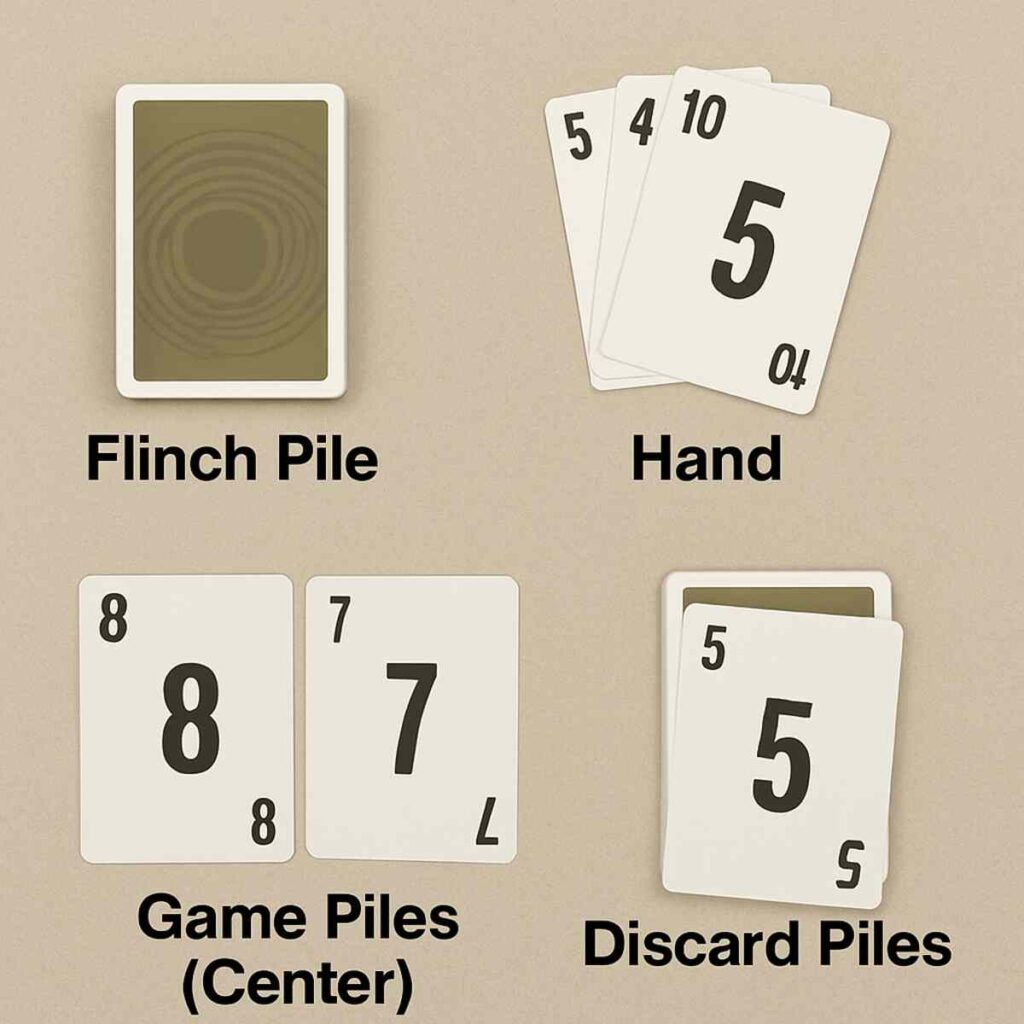
The entire setup revolves around these four areas. Think of them as your personal dashboard and a shared space where all the action happens. Knowing the purpose of each pile will help you move from confused to confident.
Here are the four essential piles and what they do:
- Flinch Pile: This is your personal 10-card stack, dealt face-up. Your main objective is to play every card from this pile to win the game.
- Hand: A starting hand of five cards that you use to make plays. You’ll draw back up to five cards at the start of your turn.
- Game Piles: These are shared piles in the center of the table that everyone plays on. Like the foundations in Solitaire, they are built sequentially from 1 to 15.
- Discard Piles: Your personal holding areas where you place a card from your hand to end your turn when you can’t make any more plays.
How to Set Up a Game of Flinch in Under 2 Minutes
Ready to deal? The Flinch game setup instructions are straightforward and work the same whether you have two players or a full table of eight. Once you do it once, you’ll have it memorized.
To start, follow these two simple steps:
- Shuffle and Deal the Flinch Piles: Give the entire 150-card deck a thorough shuffle. Then, deal a pile of 10 cards, face-down, to each player. This is each person’s personal Flinch Pile. Place it directly in front of you but don’t look at the cards yet!
- Create the Stock Pile: Place all the remaining cards face-down in a single stack in the center of the play area. This becomes the Stock Pile, which acts as the main draw pile for the whole game, much like the draw pile in Uno or Solitaire.
With the piles dealt, every player now performs one last action to complete the setup. Each person draws the top 5 cards from the central Stock Pile to form their starting Hand. That’s it! You should now have your 10-card Flinch Pile on the table and 5 cards in your Hand.
What Do I Do On My Turn? The Simple Flinch Gameplay Loop
A turn in Flinch is a simple, fast-paced race to play your cards onto shared “Game Piles” in the center of the table. Think of these like the foundations in Solitaire—anyone can play on them, and they are built sequentially from 1 up to 15. Any time a player has a “1” card, they can use it to start a new Game Pile.
Your top priority is always your Flinch Pile because getting rid of it is how you win the game. On your turn, the first thing you must do is look at the face-up card on your Flinch Pile. If that card can be played onto a center Game Pile, you must play it before making any other moves. For instance, if a Game Pile shows a “7” and your Flinch card is an “8”, you play it immediately!
A turn in Flinch follows a simple rhythm, and you can keep playing as long as you have cards that fit. Here’s the sequence:
- Play Your Flinch Card: First, check if the top card of your Flinch Pile can be played. If it can, you must play it.
- Play from Your Hand: Now, you may play any cards from your hand that can be played onto the Game Piles.
- End Your Turn: When you can’t (or don’t want to) make any more plays, you must end your turn by choosing one card from your hand and placing it face-up on the table near you. This starts one of your personal Discard Piles.
Once you discard a card, your turn is officially over. This action signals to the next player that it’s their go. But pay close attention to that first rule—playing from your Flinch Pile is mandatory. Forgetting to do so gives your opponents a chance to shout “Flinch!” and put you at a disadvantage, which is where the game gets its thrilling edge.
The “Flinch!” Rule: How to Seize Your Opponent’s Missed Opportunity
The game gets its name from this very rule, which keeps every player on high alert. A “Flinch” occurs when a player’s turn begins and they have a playable card on top of their Flinch Pile but fail to play it first. Let’s say a center Game Pile shows a ‘4’, and your opponent’s Flinch card is a ‘5’. If they overlook this and try to play a card from their hand instead, any other player can immediately shout, “Flinch!” This simple action instantly stops their turn and introduces a penalty.
So, what’s the consequence for flinching? It’s a double whammy. First, the player’s turn is over on the spot—they don’t get to make any more plays. Second, and more painfully, the card they should have played is now taken and placed at the bottom of their Flinch Pile. This buries a useful card and pushes them further from their goal. This rule is crucial, as paying attention is one of the most effective winning strategies for Flinch.
Calling “Flinch!” doesn’t just penalize one player; it creates a thrilling opportunity. The moment a flinch is called, and the offending player’s turn ends, the game pauses. Now, any other player who has a card of that same number (in this case, a ‘5’) can immediately play it, jumping in out of turn. This can trigger a cascade of plays from anyone who has the next card in sequence, allowing someone to seize momentum before play resumes. Mastering these Flinch card game rules for beginners is how you turn a simple mistake into a game-changing advantage.
How to Win a Round and Keep Score for Game Night
After all the frantic plays and near misses, how do you actually claim victory? The goal is beautifully simple: be the first player to empty your 10-card Flinch Pile. The moment you play that last card, the round instantly ends, and you’ve won. There’s no feeling quite like watching that final card leave your pile and knowing you’ve outpaced everyone else at the table.
Winning the round is the first step to winning the game night. The standard method for Flinch scoring explained is straightforward: the winner receives one point for every card left in their opponents’ Flinch Piles. For example, if you win while your opponents have 2, 5, and 8 cards remaining, you score 15 points for the round. Many people play to a target score, like 50 or 100, to crown an overall champion.
Once you’ve tallied the points, resetting for the next round is easy. Just gather all 150 cards from every pile on the table—the center Game Piles, everyone’s Discard Piles, and all remaining hands. Shuffle them together thoroughly, deal again, and you’re ready for more fast-paced fun.
3 Simple Strategies to Win Your First Game of Flinch
While luck plays a part, the best players use a few simple winning strategies for Flinch that give them a consistent edge. You don’t need to be a card shark; you just need to think one step ahead. By focusing on how you play your cards, not just when, you can significantly improve your chances of winning.
The most important mindset shift is to treat your personal discard piles as a tool, not just a trash heap. Always prioritize playing a card from your Flinch Pile if you can—that’s your number one goal. But when you can’t, organize your discards. For example, if you have a 7, 8, and 10 in your hand, try to discard the 10 first, then the 8 on a different pile, and save the 7. This sets you up to play them in sequence later, clearing your hand for more plays.
Beyond managing your own cards, a key part of learning how to master the Flinch card game is paying attention to your opponents. Is the player to your left showing a ‘4’ on their Flinch Pile? If you have a ‘1’ in your hand, you hold all the power. By choosing not to play your ‘1’ to start a new Game Pile, you can block them from making their most important move. A little defensive thinking can completely stall their progress and give you the time you need to pull ahead.
These simple tactics—prioritizing your Flinch Pile, organizing your discards, and blocking opponents—transform the game from a race of pure luck into a light-hearted battle of wits. If this style of strategic discarding and sequence-building feels familiar, you may have played its popular cousin, Skip-Bo. But while they seem similar, the Flinch vs Skip-Bo rules create surprisingly different games.
Flinch vs. Skip-Bo: Which Century-Old Classic is for You?
If you’ve played Skip-Bo, the race to empty a central pile feels instantly familiar. The biggest difference in the Flinch vs Skip-Bo rules lies in the cards themselves. A Flinch deck is a straightforward sequence from 1 to 15. Skip-Bo, however, only goes up to 12, but adds powerful wild “Skip-Bo” cards. These wilds can be played as any number, injecting a dose of luck and allowing players to escape tricky situations that would stop a Flinch player in their tracks.
Another game-changing difference is where you discard. In the Flinch card game, your discard piles are yours alone, letting you carefully set up future plays. In contrast, Skip-Bo uses shared discard piles in the center that any player can play from. This creates a more chaotic and reactive environment, as an opponent might use a card you were hoping to save for yourself, forcing you to constantly adapt your plans.
So, what does this mean for you? If you enjoy a game with more personal control where you can carefully plan several moves, Flinch is your classic. You win by methodically out-thinking your opponents. If you prefer a faster, more unpredictable game where a single wild card can change everything, you might lean towards Skip-Bo. Both are fantastic card games like Flinch, but one rewards foresight while the other celebrates the thrill of a lucky break.
Your Top Flinch Questions Answered
Can you play Flinch with regular playing cards? The answer is a creative yes! You can approximate the game by shuffling three 52-card decks together. Use Aces for 1s and face cards for 11 (Jack), 12 (Queen), and 13 (King). This is a perfect way to try the mechanics before you buy a dedicated set, even without the 14s and 15s.
The reason these old decks are so common is the fascinating Flinch game origin and history. Invented in 1901 by Arthur J. Patterson, it was a smash hit that sold millions of copies in its first few years. It became a household name long before most modern games existed, cementing its place as a true American classic passed down through generations.
Finding an old box often sparks questions about its vintage Parker Brothers Flinch value. While rare or mint-condition editions are certainly prized by collectors, most common sets from the mid-20th century are valued more for nostalgia than for money. Their true worth is in the fun of rediscovering and sharing a piece of history with your family.
If you’d rather start fresh, you can often buy the Flinch 100th Anniversary Edition online. For a quick, no-commitment trial run, you might even find a Flinch online game free to play on various websites. Now that you know the story behind the cards, you’re ready to learn how to deal them out.
You’re Ready to Play: A 3-Step Plan for Your First Flinch Game
The rules of Flinch might have seemed daunting, but you now know to confidently lead your first game. Your journey from beginner to game leader follows three simple steps. These core rules are all you need to remember for a successful game night:
- Set Up Your Piles. Deal out the 10-card Flinch Pile to each player and a starting hand of five cards—this is your launchpad for the game.
- On Your Turn, Play Your Flinch Card First. The most effective of all winning strategies for Flinch is always to check if you can play the top card of your Flinch Pile.
- Yell ‘Flinch!’ When Opponents Miss Theirs. Keep an eye on everyone’s Flinch Pile. Calling out a missed opportunity is a key part of the fun and strategy.
You now see Flinch not as a dusty relic, but as a source of fast-paced, accessible fun. You have the rules, the setup, and the core strategy. Grab that deck, gather your players, and deal your first round tonight. You’re ready.