
Ever called a real estate agent about a home you loved, only to get sent to voicemail? It’s a frustrating moment that can cost an agent a sale. In the fast-moving world of real estate, speed is everything, and a new kind of technology is ensuring no call ever goes unanswered again. Select the BEST AI VOICE AGENTS FOR REAL ESTATE.
An AI voice agent for real estate is like a super-powered receptionist who works 24/7, never takes a break, and can handle countless calls at once. It’s a specialized program designed to be the first point of contact for your business, ensuring every caller is greeted instantly.
This is fundamentally different from the assistant on your phone. While consumer AI like Alexa is built for personal tasks, a professional voice agent is a focused business tool. Its job is to ask business-critical questions, like “Are you pre-approved for a mortgage?”, helping agents prioritize their day.
In practice, this AI handles three simple but vital steps. It answers every call with a professional greeting. It provides immediate answers to basic questions, like “Is that home still available?” And it carefully captures the caller’s contact information, guaranteeing a human agent can always follow up later.
The 3 Game-Changing Benefits You’ll See Immediately
What if you could clone yourself? For a busy real estate agent juggling showings, paperwork, and constant calls, it’s a tempting thought. While that’s still science fiction, an AI voice agent is the next best thing. It’s a tool designed not to replace you, but to handle the repetitive tasks so you can focus on what matters most: your clients and closing deals.
The impact is immediate and boils down to three huge advantages. You’ll find yourself able to:
- Save 10+ Hours a Week by automating repetitive calls and scheduling.
- Capture 100% of Leads by ensuring every call is answered instantly, 24/7.
- Provide Instant, World-Class Service to every single caller, day or night.
Think about the difference. Before, your morning might start with a long list of missed calls—some urgent, some just asking about property taxes. After, you start your day with a neat summary from your AI, highlighting two serious buyers who are pre-approved and want to book a showing. The AI already answered the simple questions for everyone else.
Your First Line of Defense: How AI Guarantees You Never Miss a Lead Again
The perfect buyer for your new listing might call at 9 PM on a Saturday, right when you’re sitting down to dinner. In the past, that call went straight to voicemail—a lead that could go cold by Monday. An AI voice agent acts as your 24/7 front desk, guaranteeing that every single call is answered professionally, whether it’s lunchtime or the middle of the night, ensuring you provide top-tier service for 24/7 real estate lead engagement.
What happens when your new listing gets a surge of interest and ten people call at the same moment? A human can only answer one phone line, but an AI agent is different. It can handle a virtually unlimited number of calls simultaneously, a key factor that helps reduce real estate agent response time to zero. This eliminates the risk of a potential buyer hearing a busy signal and hanging up for good. Each caller gets an immediate, personal-feeling response.
More than just answering, the AI voice assistant for property listings is designed to gather crucial details. It politely asks for the caller’s name, phone number, and the property they’re interested in. All this information is then organized and sent directly to you, creating a perfect log of every opportunity. Instead of a jumble of voicemails, you have a clean list of new leads.
The End of Repetitive Questions: Instantly Answering “Is It Still Available?”
Taking a message is helpful, but the real time-saver is eliminating the need to call back in the first place. Think about how many times a day you answer the same basic questions: “Is the house on Elm Street still for sale?” or “What’s the square footage?” Each of these calls breaks your focus and eats into your day, pulling you away from high-value tasks like negotiating offers or meeting clients.
This is where a true AI voice assistant for property listings becomes more than an answering machine. By connecting directly to your property information—the same details you post on the MLS or your website—the AI can “read” the facts about each home. It’s no longer just taking a message; it’s providing real-time information as if it were your personal, fully-briefed assistant. It always knows which properties are active, under contract, or sold.
The result is a powerful natural language conversation AI for realtors that handles the initial Q&A. When a caller asks if the home has a fenced-in yard or what school district it’s in, they get a correct answer right away. This simple step delights buyers with instant service and filters out callers who aren’t a good fit, saving you hours of phone tag while ensuring every interested party gets the information they need to move forward.
The Scheduling Superpower: Can AI Really Book Property Viewings?
Scheduling a viewing should be simple, but it often becomes a frustrating game of phone tag and back-and-forth emails. After an AI has answered a buyer’s initial questions, the next logical step is booking a visit. But can an AI really schedule property viewings without creating a mess of an agent’s calendar? The answer is a resounding yes, and it works more smoothly than you might think.
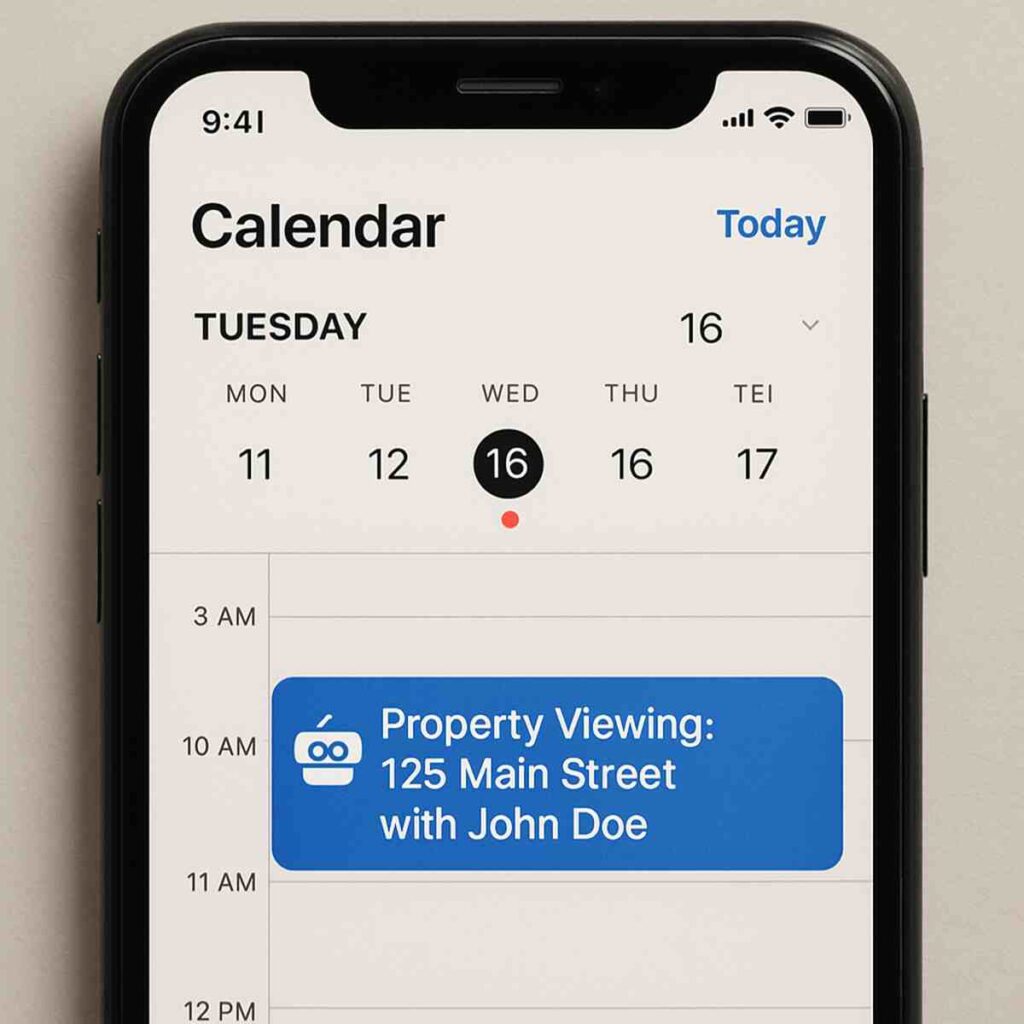
The process is as seamless as talking to a human receptionist. First, after a caller expresses interest in a viewing, the AI voice agent asks them what days and times they are available. Then, it securely checks the real estate agent’s personal calendar for open slots that match the caller’s availability. Finally, it offers one or two of these confirmed openings. Once the caller agrees to a time, the AI instantly books the appointment on the agent’s calendar and sends a confirmation to both the agent and the buyer.
What this means for the agent is the end of scheduling chaos. Instead of a messy inbox filled with “Are you free Tuesday?” or a list of calls to return just to coordinate times, they simply see new, confirmed appointments appearing on their calendar. All the contact details and notes are saved automatically, ensuring no opportunity is lost. The agent’s most valuable resource—their time—is protected.
The “Serious Buyer” Filter: How AI Saves Your Most Valuable Asset—Time
A real estate agent knows that not all calls are created equal. For every person ready to make an offer, there are a dozen just browsing. The biggest challenge isn’t just answering the phone; it’s figuring out which conversations deserve an agent’s immediate, personal attention. This is where an AI voice agent proves it’s more than just a scheduler—it’s a powerful filter.
Instead of just booking an appointment, the AI can intelligently gauge a caller’s seriousness. It does this by asking a few simple, low-pressure questions during the natural flow of the conversation. This isn’t an interrogation; it’s a way to gather helpful context so the human agent can provide the best possible service when they follow up.
To do this, the AI might ask questions like:
- Are you already working with an agent?
- Have you been pre-approved for a mortgage?
- When are you hoping to move by?
Based on the answers, the AI doesn’t make a decision, it simply organizes information. It can flag the most promising buyers—like someone who is pre-approved and needs to move in 30 days—and leave a note for the agent. This means that instead of starting their day with a long, random list of calls to return, the agent sees a prioritized summary of their best opportunities. This simple act of automated lead qualification allows them to focus their valuable time on the people they can help the most, right now.
A Day in the Life: Agent Sarah “Before and After” AI
Consider Sarah, a busy real estate agent. Her “before” mornings were a blur of caffeine and catch-up. She’d start her day sifting through a long list of missed calls, spending hours returning them, only to find most were basic questions or dead ends. All that time playing phone tag meant less time for the parts of her job that actually close deals, leaving her feeling constantly behind.
Now, with an AI voice agent, her workday starts completely differently. Her AI answered every call overnight, handling simple inquiries and booking three property viewings directly into her calendar. She wakes up to a perfectly organized schedule, not a stressful list of chores.
Instead of a messy call log, Sarah sees a clean summary. Her AI has already flagged two callers as high-priority: a pre-approved buyer and a homeowner ready to sell. She can spend her first hour having meaningful conversations with people who are ready to act, not chasing down cold trails.
The transformation is clear. The AI didn’t replace Sarah; it gave her back her most valuable asset—time. By automating the repetitive tasks, it frees her to focus on building relationships and negotiating offers. She’s less of a call operator and more of the expert agent she was meant to be.

AI Voice Agents vs. Human Assistants (ISAs): Which Is Right for You?
Seeing Sarah’s transformation, you might wonder if this technology replaces the need for a human assistant. Many agents hire an “Inside Sales Agent” (ISA)—a person dedicated to answering calls and finding serious buyers. When you’re looking for help, how does an AI voice agent stack up against a human ISA?
The key differences come down to cost, availability, and the nature of the work.
- Cost & Availability: A human ISA is a salaried employee who works set hours. An AI voice assistant works 24/7 for a predictable monthly fee that’s a fraction of a salary, ensuring no call ever goes to voicemail.
- Consistency vs. Nuance: An AI will ask your qualifying questions perfectly every time without getting tired. A person excels at navigating complex, emotional conversations and building the kind of rapport that makes clients feel truly heard.
This is why the most effective real estate teams don’t see it as an “either/or” choice. Instead, they build a powerful hybrid team. The AI acts as a tireless front line, instantly handling every incoming call to filter out basic questions and wrong numbers. It then passes the most promising leads directly to the human ISA, who can dedicate their time to high-value conversations.
Ultimately, the goal isn’t to replace people, but to supercharge them. The AI handles the high volume of repetitive work, freeing up your human staff to focus on what they do best: building relationships and closing deals.
“Will My Clients Hate Talking to a Robot?” Addressing the Human-Touch Concern
It’s the first question on every agent’s mind, and it’s a valid one. We’ve all been trapped by robotic “press one for sales” menus that go nowhere. But the new generation of AI for real estate is worlds away from that frustration. Using advanced technology, these voice agents are designed for natural conversation, capable of understanding slang, accents, and context without forcing callers into a rigid script. To a client, it feels less like talking to a machine and more like speaking with a capable, if brief, receptionist.
Of course, an AI can’t replace the nuance of a human connection, nor should it try to. The true magic lies in the seamless handoff. The moment a caller asks a complex question or expresses frustration, the best systems are designed to do one thing: get a human involved immediately. The AI can instantly forward the call to you or send a text alert with the caller’s details and a summary of the conversation, ensuring you can step in without missing a beat. This intelligent customer service automation acts as a safety net, not a barrier.
Ultimately, your clients won’t see it as being blocked by a robot; they’ll see it as getting better, faster service. Their simple questions are answered instantly, 24/7, and their important ones are escalated to you more efficiently than ever. The AI handles the logistics so you can focus on the relationships.
The 3 Must-Have Features in Any Real Estate AI Voice Agent
Knowing that a modern AI won’t scare off your clients is the first step. The next is understanding that not all AI voice agents are created equal. Beyond just answering calls, the best tools act as a true extension of your business, equipped with features that save you time and help you close more deals. Think of it like hiring a human assistant—you need someone who is organized, coachable, and accountable.
When you’re comparing options, cut through the noise and focus on these three non-negotiable features:
- Automatic Contact Saving: The AI should act like a perfect note-taker, automatically saving a new caller’s name, number, and a summary of their conversation right into your contact list (your CRM). This ends manual data entry and ensures no lead ever gets lost.
- Customizable Conversation Scripts: You need to be in control of the conversation. A good AI lets you easily customize the script so it can ask the exact qualifying questions you would, like “Are you pre-approved for a mortgage?”
- A Simple Performance Dashboard: How do you know it’s working? The AI must provide a simple, at-a-glance report card showing you how many calls it answered, how many appointments it booked, and where your leads are coming from.
Without these core functions, an AI agent is little more than a fancy voicemail. But with them, it becomes a powerful system for growth. The automatic saving eliminates your busywork, the custom scripts ensure quality control, and the dashboard proves you’re getting a return on your investment.
Top AI Voice Agents: A Quick Guide to the Best Tools for the Job
Now that you know the three essential features every AI assistant needs, you might be wondering which one is right for you. The “best” AI voice agent for real estate isn’t a one-size-fits-all solution. A solo agent working from their car has vastly different needs than a downtown brokerage with a team of twenty. The top-rated real estate AI callers are designed to solve specific problems for specific types of businesses.
The All-in-One Assistant: For the Hustling Solo Agent
For the busy solo agent, life is a constant juggling act. You’re the marketer, the salesperson, the scheduler, and the accountant, all in one. You don’t need a complicated system; you need a simple, reliable partner that just works. This type of AI agent is built for exactly that. It focuses on getting the essentials right without any technical headaches.
These tools are designed for a quick setup—often in less than 15 minutes. They connect to your personal calendar, answer calls with your custom script, and text you the details of important conversations. It’s the simplest way to ensure you never miss a call while you’re in a showing or meeting.
- Best for: Solo agents, ease of use, and quick setup.
The Team Coordinator: For Growing Brokerages
On the other hand, a growing brokerage faces a different challenge: volume and coordination. When you have dozens of calls coming in for multiple agents, the biggest risk is having a hot lead fall through the cracks. This is where a more powerful AI assistant shines.
Think of this tool as an air traffic controller for your leads. It can handle hundreds of calls at once and, most importantly, can be programmed to route callers to the right agent. For example, it can send calls about a downtown condo to your city specialist and calls about a suburban house to another agent, all automatically. For team leaders, its advanced dashboards show exactly how many leads the team is handling and who is following up.
- Best for: Large teams, high call volumes, and advanced lead routing.
The Renter’s Concierge: For Property Managers
What about real estate professionals who aren’t focused on sales? Property managers deal with a unique and relentless stream of questions, from rental applications to maintenance requests. Answering the same questions about pet policies or utility costs all day is a huge drain on time.
For this market, specialized conversational AI for property management has emerged. These tools are pre-trained to handle the specific vocabulary of renting. They can answer a prospect’s questions about available units, schedule a viewing, and even log a maintenance request from a current tenant, instantly notifying the right person to handle the repair. It frees up property managers to focus on filling vacancies and keeping tenants happy.
- Best for: Property managers, handling rental inquiries, and automating maintenance requests.
Ultimately, choosing from the best AI voice agents for real estate comes down to honestly assessing your daily workflow. By matching a tool’s strengths to your biggest pain points—whether it’s just you or you’re managing a hundred properties—you can find a solution that truly feels like a new member of the team.
Your First 3 Steps to Getting Started with an AI Voice Agent
Once you have an idea of the right tool for your business, getting your first AI voice agent working is less about being a tech expert and more about making a few simple business decisions. The entire real estate AI setup boils down to just three straightforward steps.
Here’s your quick-start checklist:
- Pick One Goal. What’s the single biggest task you want to hand off? Start with something simple and high-impact, like making sure you capture every single after-hours call.
- Write Your “Golden Script.” Decide what you want the AI to say. A professional greeting followed by an offer to answer common questions or schedule a viewing is a perfect start.
- Connect It to Your Number. This sounds complicated, but it’s not. Most services make this a one-click process to forward calls from your existing business line, getting you up and running in minutes.
And that’s it. By focusing on your goal instead of the technology, you can delegate your first task and immediately start saving time.
The Future Is Calling: How AI is Becoming an Essential Tool, Not a Novelty
This technology represents a fundamental shift from being constantly interrupted to being strategically informed. Instead of spending your day reacting to every ringing phone, your AI assistant allows you to start the day by reviewing a short, curated list of the most promising buyers. This is the crucial difference between being busy and being truly productive, letting you focus on the human connections that close deals.
Think about how the cell phone changed the industry. At first, it was a luxury for top performers. Today, you can’t imagine an agent working without one. The best AI tools for real estate are on the same path. What seems like a high-tech advantage today is quickly becoming the new standard for client communication. The future of real estate tech isn’t about replacing agents; it’s about equipping them to handle more business, more effectively, than was ever possible before.
This shift isn’t a distant prediction; it’s already underway. Agents who embrace this technology aren’t just buying a gadget—they are buying back their time and ensuring no opportunity slips through the cracks. They are setting a new bar for service that will be difficult for others to match.
Your Action Plan: Take This Step in the Next 10 Minutes
An AI voice assistant is a practical tool to ensure no call goes unanswered and no opportunity is missed. You are now equipped to start planning your strategy.
Take the first small step by creating a simple real estate action plan. Grab a piece of paper and write down the top five questions you answer repeatedly. That list isn’t just a collection of annoyances—it’s the job description for your first AI assistant. By defining these tasks, you’ve taken a concrete step toward improving your real estate lead follow up and reclaiming your most valuable asset: your time.